Showing posts with label black history month. Show all posts

Learn Your History: Painting Our Lost Past: Lois Mailou Jones

If you are fortunate to have opportunity, it is your duty to make sure other people have those opportunities as well.
~ Kamala Harris

Gif Source

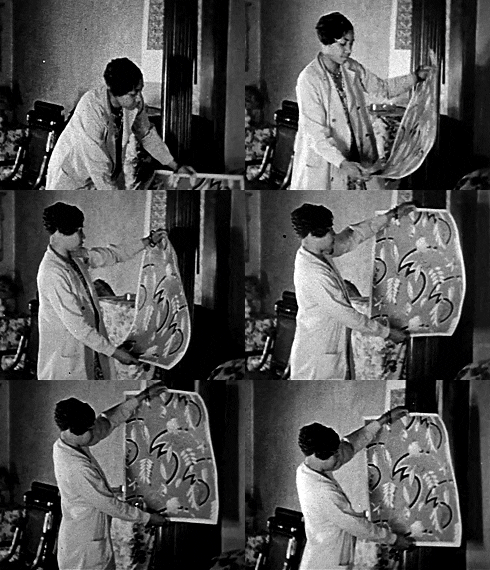
I wrote about Augusta Savage, whom I believe was responsible for the multicultural art world we live in today, and paved the way for artists like Mickalene Thomas and Kara Walker. To close the month, I want to introduce you to Mailou Jones, another Harlem Renaissance artist. As with Augusta, I won’t give you information you can read from the links down below. I will, however, share her story and how it impacts our lives in these modern times.

I am inspired by Mailou Jones because our lives are very similar, yet very different. She grew up loving art and her parents encouraged her to express her creativity. She remained passionate and further developed her talent. I've mentioned before how fortunate I am to have been raised by supportive people and given opportunities and experiences that would otherwise have been fantasy for me. She was also fortunate to have supportive people in her life, and was able to attend high school. 
According to her interview, she was also able to earn many scholarships that allowed her to pursue higher education, and even travel abroad. Even though she was well-received and able to accomplish so many of her goals, she was limited. Her talent could only take her so far in a world where she was deemed inherently less-than. She said, “this country wasn't interested in exhibiting our work or allowing us any of the opportunities that the white artists enjoyed. I made up my mind at that moment that I would go to Paris.” (Rowell) 

I’m currently studying French, and her stay in France was brought forth by the “egalitaire” (not so racist) culture. I’ve read many biographies of other black artists (including Augusta Savage) and many of them wind up in Paris. I want to experience for myself the difference between modern-day French and American culture. Even though she didn’t speak the language, her translator (and friend) did her best to make that year magical. She met other famous artists and worked on a variety of projects. Living la belle vie indeed.

Life is full of many struggles, but she chose to look past them and focus on what she could do and how she could do it to reach her goals. I’d call her an optimist. Besides her life-story and vibrant personality, her artwork is a treasure itself. While in France she focused on capturing the natural beauty of the vineyards, but later on decided to change her style. Haitian and African culture were heavy influences on her later work. You may recognize her painting Les Fetiches of African masks. It’s my personal favorite.

Add caption
Haitian culture is often misunderstood (the positive term) by other cultures. Vodou is seen as “dark magic” full of strange rituals and the Haitian people were, and still are, looked down upon. (Although many famous artists did develop their style based off of patterns, colors, and prints of African culture. But that topic is for another day.) The concept that something as refined as art could be influenced by non-European cultures was shocking. Yet, she went against the status quo. 

It's 2019, which means it's been 99 years since the start of the Harlem Renaissance! How much has changed since then? It's all thanks to our brave predecessors who have paved the way with their own two feet for the rest of us. Despite the racism, despite the segregation, despite being the children of slaves, women like Lois and men like Garrett came out on top. We have opportunities and privileges that were not available even 20 years ago, but we also have many issues we have to face and overcome to continue progressing as people of this country. Let's make them proud.

I wish I could have a little gallery of all of her paintings, but I can’t. That would be copyright infringement. So, make sure to click on the links down below for more info on our amazing Black woman of the week! And don't forget to leave a comment down below. 


Sources

Learn Your History: Sculpting the New Age: Augusta Morgan

I have created nothing really beautiful, really lasting, but if I can inspire one of these youngsters to develop the talent I know they possess, then my monument will be in their work.
~Augusta Savage

Giphy Source
How many people have you met that left you awestruck? 
Just hearing their voice and conversing with them opened up your worldview to wide you were left speechless. When researching Black Female artists, I found Augusta Savage, and I have nothing more to say.

Aww, I can’t resist. I spent all week researching Black Female Artists, because of my fascination with empowered women who’ve paved the way for me, and all future generations. You see, Augusta Savage is the woman who began the push for Black artists to be the ones to incorporate African culture and tradition into their works. Her sculptures have the heart and soul of a woman who has been both ostracized and recognized for her talents from a young age. I relate to her and am greatly inspired by her, and I hope you will be too.

Before this week, I thought I’d never heard the name Augusta Savage, but, I was wrong. I simply didn’t remember her. Through remembrance our predecessors live on, and when reading articles and researching individual pieces, I saw a photo of The Harp. I Suddenly, I knew her again. The Harp is a beautiful work of art that portrays the ancient instrument through a choir of black women, ending with a black man. The art world looked down on Black artists and felt they had nothing to contribute. Even though many artists were inspired by traditional African styles (as well as many non-European cultures), African-American artists were less-than solely because of the color of their skin.

Stop and rest your mind for one moment. Imagine the most beautiful painting, the Mona Lisa or Starry Night. A work of art, praised for its originality, its ability to portray the world in a way seen through the eyes of a genius. What race do you assume the artist is? What gender? Would you like the piece any less if you discovered the creator of such a magnificent piece was a woman? If they were Black? How about a Black woman?

I could go into great detail about race relations, segregation, denied opportunities et cetera, but this isn’t a research paper. This is as common knowledge. In a society where citizens are systematically treated as second-class citizens through public and private policies (as well as social situations) due to their race, the correlation is clear. However, her talents were realized and acknowledged by wonderful people who wanted to help her reach her full potential, despite the social climate of the time. Her tenacity and faith in herself and her abilities helped her push through and do what she was always meant to do.

What if I never met Julia? What if my art teachers weren't all amazing women? (Yes, all of my art teachers have been women) I remember glazing tiles with my stepmom in her studio. I would be given clay to make my own creations and paper to draw on. I was surrounded by professionals who all believed in giving back to the community through CPAG (Chicago Public Art Group) and providing the resources needed for those who had none to let their creativity flow and make the world a more colorful place.

The feeling of creating something on your own is amazing, and the feeling of that work being recognized by others gives the satisfaction of being accepted. I took metalsmithing one summer, and worked with ASM (After School Matters) once I was old enough. We spent the whole summer learning to design and cut tile, and our mosaics remain a part of the city’s walls. Like Augusta, I’ve been given many opportunities that were not available to those of similar backgrounds, and I am very grateful. From her experiences, and my own, I see how amazing and necessary it is for those who have (opportunities, privileges) to help those who do not.
From her experiences, I've learned to see my life from a new perspective, and have gained more confidence in my abilities. I hope you’ve been inspired to be thankful for all the opportunities and privileges you have, and use them to help others who are not as fortunate. I did not go into great detail on her life story, and that's okay; all of my sources are down below, and it's better you read them for yourself.

Learn Your History: Fact or Fiction: Garrett Morgan

Start where you are, with what you have. Make something of it and never be satisfied
~George Washington Carver

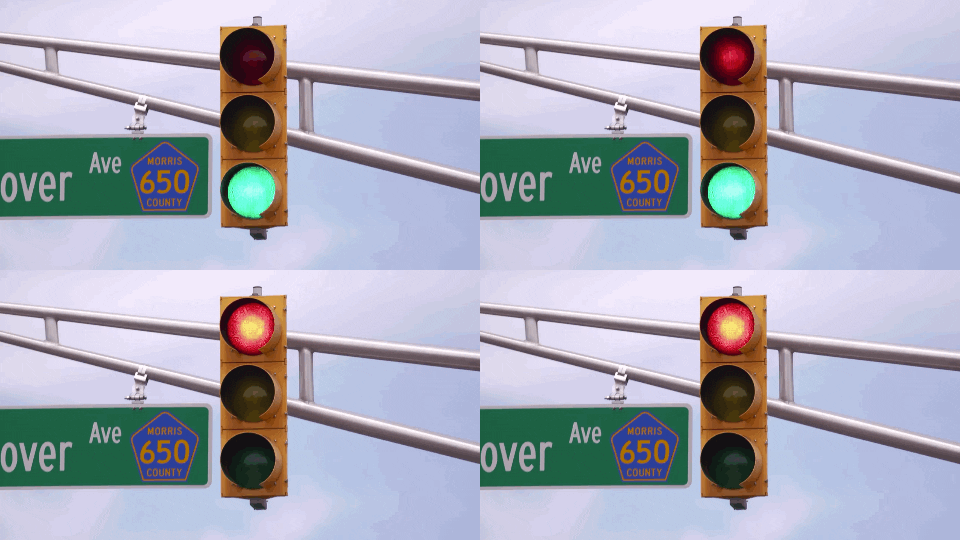
Another day another opportunity to learn US history. 
This week I've decided to focus on a Black inventor who's name is not well-known. George Washington Carver was the only name I could think of, and one is definitely too small a number in 2019. I remember being told once (or many times, I've forgotten) that a Black man was the one who invented traffic lights, and also being told that I was lied to, so let’s begin there. His name is Garrett Morgan (1877-1963), and he was born the son of a former slave and the grandson of a Confederate colonel. He was a master inventor, creating the first chemical hair straightener for Black hair (a.k.a. relaxer), a sewing machine, the predecessor to the gas mask, and the traffic light.

Fact or Fiction
According to LiveScience, Garrett Morgan did not invent the first traffic light, that honor goes to Lester Farnsworth Wire, whose creation looked like a birdhouse on a pole, that was placed right in the middle of an intersection. You may remember this from old cartoons like "Pink Panther" where an officer stands in the middle of the street, blowing a whistle, pulling a lever to change the colors from red to green. Although, this honor should also go to multiple other inventors, I believe because all of these inventions had to start somewhere. This tale begins on the British railroads, where train traffic needed to be better controlled, then continues in America, where various variations of the stoplight, or traffic light, were patented.

I want to give credit where credit is due, so Garrett Morgan did indeed create the traffic light, the one that we know and love today. You see, the stop-go method left when and how soon to stop to the driver’s discretion. Depending on the speed of the car, someone could be left in the intersection, while another car hits the gas. The "three color system" was invented three years before Morgan's invention, but this doesn't take away from its importance, since Morgan was the one who decided it best to stop all lanes of traffic before giving a lane the green light. This allowed better control of the flow of traffic, and made intersections significantly safer. His invention was also far cheaper to manufacture and once he sold it to General Electric, thousands were able to mass produced across the country.

Dreams not Differed
The tale of the traffic light is enjoyable to read, but unfortunately the process to gain recognition for his inventions became far more difficult once it was uncovered by the media (newspapers) that Garrett Morgan was a Black man (the horror!). While his ads for “hair straightener creams” and combs made sure to include his picture (a largely Black audience), he hired a white actor to pretend to be him when convincing white patrons to take his next invention seriously. Worried for the safety of firemen who inhaled smoke and ash from fires, he created a special breathing masks that blocked the smoke, preventing pollutants from floating into their lungs.
He dreams were not deterred nor differed, and he continued to live his life with pride in himself, and eventually, was given the respect he always deserved. I hope you enjoyed learning about such a unique man today, and are inspired by both the joyous and sad times in his life. Don’t forget to leave a comment down below!

Gif Source
Sources
Biography.com Editors. “Garrett Morgan Biography”. Biography.com. Biography.com website. 15 January 2019. February 13, 2019. Web. <https://www.biography.com/people/garrett-morgan-9414691>.
“Garrett Augustus Morgan”. Who Made America?. PBS. [2004?]. February 13, 2019. Web. <http://www.pbs.org/wgbh/theymadeamerica/whomade/morgan_hi.html>.
History.com Editors. “Garrett Morgan Patents Three-Position Traffic Signal”. HISTORY. 13 December 2018. February 12, 2019. Web. <https://www.history.com/this-day-in-history/garrett-morgan-patents-three-position-traffic-signal>.
Mark Traffic. “Traffic Lights Invented by William M. Potts”. Mark Traffic: All That is Mobile. 16 October 2010. February 13, 2019. Web. <http://www.marktraffic.com/traffic-lights-invented-by-william-l-potts.php>.
Moss, LeAnn. “45 Quotes from Black Leaders on Mindset, Progress, and Making an Impact”. Bossedup. Bossedup.org, Feb 2018. February 8, 2019. Web. <https://bossedup.org/45-quotes-from-black-leaders-on-mindset-progress-and-making-an-impact/>. Ross, Rachel. “Who Invented the Traffic Light?”. Live Science. LiveScience.com. 16 December 2016. February 13, 2019. Web. <https://www.livescience.com/57231-who-invented-the-traffic-light.html>.

Learn Your History

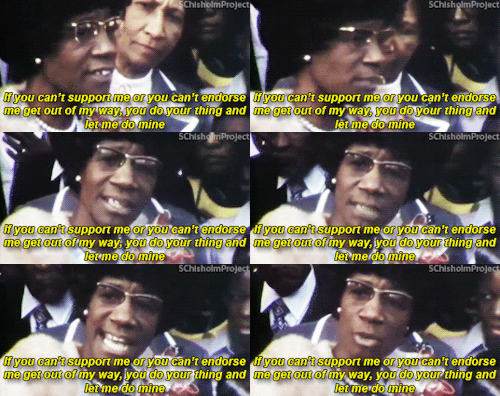
You don’t make progress by standing on the sidelines, whimpering and complaining. You make progress by implementing ideas.
– Shirley Chisholm
I haven’t taken a history class in two years. That’s right, since college, history has been a no. I'm learning French history, which is very useful since I want to go to France, but the gaps in my knowledge bother me. It's February, and I want to take more time to learn Black history. If you don’t know why it matters so much to me that I learn Black history, or even why we should all learn Black history, read on.

I went to a predominately Black, Roman Catholic grade school in Hyde Park. I specify Roman Catholic, because I did not attend CPS (Chicago Public Schools) and yes, there is a difference. We learned about Black history every February and my classmates and I would perform as historic figures every year for the entire school. I was Shirley Chisholm, and was very proud since all the teachers said I reminded them of her. You see, Shirley was a very confident, outspoken Black woman who paved the way for future generations of politicians from underrepresented populations. I was a very outspoken and confident child, at least when it came to my passions. (She also looked a bit like my Granny when she was younger, but I could just be seeing things)

The faculty and staff were a mixture of Black and White adults, younger and older, Christian and Jewish. Hyde Park is a rather affluent neighborhood, full of young college kids attending the University of Chicago, as well as professors and their families. Students would visit and teach us about law, science, and the wonder that is a college education. My teachers wanted us to be proud of our cultures and see ourselves thriving in the world. It was a unique childhood.

Most students, as I’ve come to know, did not come from this type of background. Many don’t know Shirley, or Jesse Owens, Mae Jemison, or even Thurgood Marshall. (Seriously, how can you not know Thurgood Marshall?) I can name so many historical figures that are White (majority males), that it feels as if Black people didn't contribute to US History in any way? I know. Just typing that makes me VERY angry, but it's the truth. The whitewashing of history is a common practice in this country. Newsflash: Black history is US history. In fact, Native American history, Asian American History, Polish American History, etc. - you get the picture - all make up the whole of American history. The lives of your family, friends, and neighbors is affected by the past. The past created this present.  
Every week I’ll research a Black historical figure, and tell you all about them in relatable ways. The history we learned in grade school was not the same as high school, and now that we’re adults there’s no excuse not to know all the nitty-gritty details of the lives of those we celebrate, or admonish. One month isn’t enough time to understand an entire culture, but I hope every post educates you on the lives of those who are different from you, AND inspires you to see the world a bit differently. 

This post was inspired by my fellow writer Paige Waskow. Check out her article on white privilege, and don't forget to leave a comment down below!

To see photos of all the people mentioned, please click their names:
Shirley Chisholm
Mae Jemison
Thurgood Marshall
Jesse Owens

Gif Source

Sources
"Jesse Owens Pictures and Images". gettyimages. gettyimages, 2019. February 8, 2019. Web. <https://www.gettyimages.com/photos/jesse-owens?family=editorial&mediatype=photography&phrase=jesse%20owens&sort=mostpopular>.
"Mae Jemison Pictures and Images". gettyimages. gettyimages, 2019. February 8, 2019. Web. <https://www.gettyimages.com/photos/jesse-owens?family=editorial&mediatype=photography&phrase=jesse%20owens&sort=mostpopular>.
Michals, Debra. "Shirley Chisholm." National Women's History Museum. National Women's History Museum, 2015. 5 February 2019. Web. <https://www.womenshistory.org/education-resources/biographies/shirley-chisholm>.
Moss, LeAnn. “45 Quotes from Black Leaders on Mindset, Progress, and Making an Impact”. Bossedup. Bossedup.org, Feb 2018. February 8, 2019. Web. <https://bossedup.org/45-quotes-from-black-leaders-on-mindset-progress-and-making-an-impact/>.
"Shirley Chisholm Pictures and Images". gettyimages. gettyimages, 2019. February 8, 2019. Web.<https://www.gettyimages.com/photos/jesse-owens?family=editorial&mediatype=photography&phrase=jesse%20owens&sort=mostpopular>.
"Thurgood Marshall Pictures and Images". gettyimages. gettyimages, 2019. February 8, 2019. Web.<https://www.gettyimages.com/photos/jesse-owens?family=editorial&mediatype=photography&phrase=jesse%20owens&sort=mostpopular>. 

Just Posted

A Fresh Start: Embrace the Spring Semester with Library Resources

 ðŸŒžAs we settle into the second semester, it's the perfect time to hit "refresh" and embrace new beginnings. The cold winter m...