Showing posts with label mental health. Show all posts

Marching on from Midterms

 by Arabella Chamberlain

So midterm grades are out, spring break is over, what now?

Photo Credit

It can feel overwhelming, especially in the last leg of the semester, to look at those midterm grades and wonder if you'll ever be able to pull that grade up. Fear not, there are tons of resources available to put you back on the path to success!

  • To start with, if you are struggling in a class, a good place to start is to have a chat with your professor. Reach out by email and set up a time to meet or just drop by office hours - they have them for a reason! Ask about what you can do differently in the course to improve. Are you getting your assignments in on time? Is something hindering your ability to learn in the classroom? Have an open, honest conversation. Your professor can't help you if they don't know you need help.
  • Request a tutor - they're here for a reason! The Learning Commons has tons of tutors available for many classes and if there isn't a tutor, we'll work on finding you one! Tutoring is a great resource for working through homework and assignments, prepping for an exam, or just learning a new study strategy or two.
  • Stop into the Peer-to-Peer Academic Space. Trained tutors are available, staffing the P2PAS in the back right corner of Stewart Memorial Library from 12-9pm Mondays through Thursdays, 12-5pm Fridays, and 5-9pm Sundays. The staff are tutors for multiple courses and can help you get connected to the right resources.
  • What is you are struggling in more than one class? Meet with an academic coach. If things feel like they are too far off-track, set up a meeting with an academic coach to help you get organized and back on top of everything. These are professional staff members who are trained on how to set you up for success - use them as a resource!
  • Lastly, as the past couple years have shown, mental health is so important and comes before academics. If you are struggling, reach out for professional help. Coe offers a number of resources available on- and off-campus. Reach out to Cathy Muller, Coe's Student Care Coordinator & Counselor.
Many of the aforementioned resources can be accessed here, unless otherwise noted.

Great Expectations

 By Arabella Chamberlain

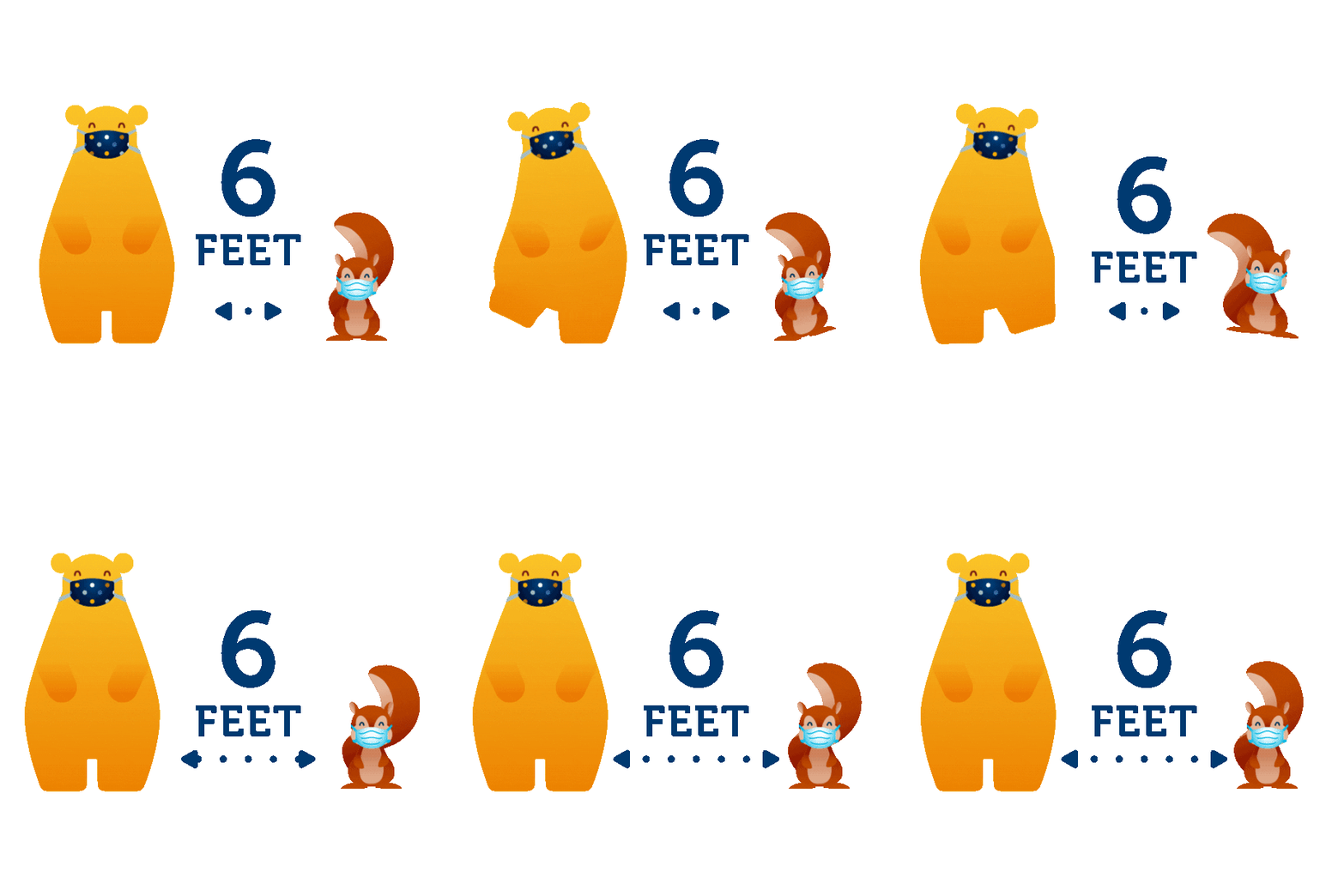
Just about a year into a global pandemic and where are we? As the weather warms, we seek the solace of sun and warmth, companionship from friends six feet away, and faces covered. But inherently, our lives are different than they were a year ago - even a few months ago.

As the world keeps turning, life has started to return to normal. Well, not really normal, more like a facsimile of the lives we once lived, filled with masks and vaccines. And where does that leave us?

We expected this to be over sooner. We expected things to be the same as they always were eventually. But they won't be.

That's okay.

Photo Credit
As our personal expectations of normalcy have waned, I found this to not be true in my experiences with academia. Professors were extremely generous our first semester online, as with the transitions to hybrid the second. But this semester, we find ourselves on the precipice of what life was like a year ago. Professors are starting to expect what they expected a year ago in class - attendance in-person, engagement, turning in assignments on time - and rightfully so. We're moving on. And strangely, things many of us never struggled with before have become a challenge to people everywhere. Expectations we used to accomplish without a second thought are now insurmountable when we can barely pull ourselves from bed.

Photo Credit
It's been a long time since we have seen professors face to face (or mask to mask), been able to go to office hours, not had to deal with buffering Zoom connections. It's truly a privilege to be where we are, and perhaps we need to remind ourselves of that next time we want to rag on a professor for pushing us a little harder than we think we can handle. You'd be surprised how much you've already endured and walked away from - maybe with a little wear-and-tear, but you're stronger for it.

I wish I could tell you all the answers to thriving in a time like this, but I don't think anyone has those answers. This is just a reminder that you've already accomplished so much, and even when this semester tries to kick your butt, know that you can kick right back. I know what it feels like when everyone around you has great expectations. But be kind to yourself. You may not always put forth your best work. You might have rough times. It's alright. Anything worth doing is worth doing badly.

Remember to take a deep breath.

And get back up again.

Because you will not let anything stop you from succeeding.


Photo Credit

How having and training your resilience can help build you up for a great semester


What is resilience? 

Resilience is the ability to bounce back from difficult situations. Didn’t do so well on an exam? Then your resilience can be shown by how hard you study for the next exam or how you might take better notes. Perhaps the role you were hoping to get was filled by someone else in your club, perhaps you take a few steps to congratulate and help the new officer with their role by telling them about the things you would have liked to do in that position.


Research done by Richard Sagor showed that students who have had more positive experiences earlier on in school show more resilience, such as, ones that proved competence, demonstrated a sense of belonging to the community, made them feel useful, or gave them a sense of agency.


Now that we are in college now, we have more independence and it can be more difficult to really get recognition that can build up our resilience. Some activities that you can do to help build resilience can include, but are not limited to…


Building a sense of competence:

It can be hard to feel that you are doing things correctly when your schedule consists of spending most of your time completing assignments to turn in the next day digitally, only to be assigned another and perhaps receive a number rating how well you did maybe a week later. 

There are lots of apps available for helping including habitica, trello, and asana to name a few.


Develop a sense of community:

It can be difficult to gain a sense of community as most of our daily lives have been transformed into a digital landscape, void of most face to face communication. However, you were fortunate enough to pick Coe College for your campus where we have lots of clubs and groups to join! 

You also aren’t limited to clubs and activities on campus. Find volunteering opportunities with a quick google search or check out this site here with a few good opportunities for students!


Feel useful:

In the last bullet point, we discussed briefly donating our time or resources to charity. You can also help a little bit more within campus by taking on roles in your club or buying seeds to feed to the squirrels. More things that you can try is to check in with some friends or set up a group chat where you can talk to your friends all at once like at a table at the caf. This would be a great chance to ask for favors and offer to help others with their own. Helping friends to the grocery store, lend some notes, or be a sounding board for a presentation or prep for a test.


Take back control of the things you can:

While there are things we cannot control, like how long we will be wearing masks for or what they’re serving in the caf, but we can take control of things such as some of the design of our rooms, our schedule, our style of notes, what activities we do in our free time, and while relaxing, this can also cause some anxiety if you have too many things that you would like to do. To help relieve this, Be aware of what you let in — Netflix, online games, social media posts. Allow yourself some space and time to declutter your mind and religiously build in “me time” into your day. This could simply be some time for quiet meditation, home workouts, or doodling. Respond to situations or people only after you’ve taken the time to think. And when you need to think, repeat step one.


Above all else, it is important to think of yourself as a learner in this situation — something you did at school and are continuing to do at college. While these are dark times, they have also given you the opportunity to get to know yourself better, to connect with how you experience the world around you. So keep calm, and learn on.

Places I Love to Go When I'm Feeling the Seven Universal Emotions

Image result for let's go out and do something gif


     As individuals, we all have our own emotions; but there are seven emotions that scientists have
deemed to be universal. They are sadness, happiness, anger, fear, disgust, surprise, and contempt.
These emotions are basic, but they can be strong sometimes. Here is a list of places that I go when
I’m feeling some of these emotions.

Anger
Ice Skating
No, I’m not the best at ice skating, but I take all of my anger and let it out on the ice.
It’s hard to be upset while doing something that’s so graceful.
Fear
Nature 
It’s like nature inspires me to be courageous; the fact that birds don’t come out of an egg knowing how
to fly, but they can take the chance and keep trying, knowing that every time they try there’s a
possibility they can fall. Another example is that every animal has a predator yet they take chances
coming out and don’t let that stop them from living their lives though every second they’re out there’s a
chance they can die. Seeing trees grow tall and proud their whole life before getting cut down along
with a million other characteristics of nature makes me want to take risks, live life, and have fun while
I can because death is inevitable. We all can’t be good at everything so there’s always a chance I can
fail, but I have to try just because there’s always also a chance that I can succeed.
Happiness
The Mall/ stores I love
When I’m happy or proud of myself, I spoil myself or the people I love because I’m in such a good
mood. I buy thoughtful “just because” gifts and also when I’m happy, I feel beautiful, so I dress up kind
of nice, and put in effort and stores are public places so I kind of show off my confidence. I also have
mini dance parties in my dorm because nobody else is watching so it’s fun and makes you feel free
and happy which is the BEST combination
Sadness
The movies or nature
When I’m outside I feel free; and something about that feeling helps my tears come out and not literally
but figuratively it almost feels like even though I’m free, I’m being embraced by the Earth because I am
one with it. The wind stops my tears by drying them, the ground soaks my tears up, and just by looking
at my surroundings I can see that life goes on which cheers me up; it’s basically involuntary advice
I’m extremely good at making myself even more sad when I’m sad; every movie has a sad point or a
few sad points, even comedies. I ALWAYS cry at the sad points and when I’m crying at the movie,
I cry even harder thinking about whatever is making me sad at the same time. It helps me to get
everything out in a way since I hate going to friends and telling them I’m sad.

I only did 4/7 of the universal emotions because I don’t have a place for disgust, surprise or contempt;
but if any of you readers have places for these, comment yours as well as your reasons why you go
there.

To Do List: Things You Shouldn't Forget About in College

To Do List: Things you shouldn’t forget about in college

Call your parents/ Guardians
-Just as much as you miss home they miss you. Don’t forget to check on them because their little babies (us) aren’t home anymore.When we’re stressed we tend to stress ourselves even more and forget about all of the people and resources who are here for us. Even just hearing my family’s voice, or their words of encouragement or that they believe in me or are proud of me motivates me to always be better and makes me so incredibly happy.

Don’t forget about your mentors
-We all have that high school counselor or mentor that helped us in some way at some point. Remember when they said “Keep in touch”? Do it! Call them whether it’s for advice, to catch up, or to vent about everything you’re stressed about. It definitely helps; especially if talking to your parents just stresses you out more and you need to talk (I’ve definitely been there too).

Take Care of you
-Being in a super hard class or having a schedule that is way too busy can take up so much time. First semester, there were so many nights I realized I hadn’t eaten since yesterday morning. There were so many hours of sleep that I lost over studying. I feel like our ability to learn and the health of our bodies definitely go hand in hand. When I haven’t eaten or slept it’s harder to retain information. Even when I get sleepy at night and ignore it, it's almost as if all of the studying goes to waste given that my brain is burned out and needs to rest.

Do things you enjoy when you get the chance
-We are all humans and we still have things we want to do, opportunities we want to take and people that we want to meet or have fun with. School is extremely important and may take up a lot of time but take a little time on weekends for yourself to reflect, do things you enjoy, and release stress you’ve been holding in all week. Life is learning, but life is also more than that so don’t forget to fully live your life!

I love college and learning how to adult. Part of growing up is finding a balance between juggling your work/school and personal life, keeping those connections that matter to you close, and remembering to stop and breathe and take care of yourself by doing those little things that are extremely important for your body to function. These are all things we forget about, so hopefully this checklist will help you remember!

It's Alive!: How to take care of your new houseplant friend

By Paige Waskow


In my last post, I shared some benefits of having plants (you can check it out here). If you are considering getting a new friend but don't want to kill it, fear not! These are a few plants that are easy to grow.


-----

1. Aloe vera: aloes are pretty common succulents that are both drought tolerant and hardy. To take good care of an aloe, give it bright indirect or direct light and water once a week. Additionally, aloes don't need as much water as say a spider plant or philodendron. They are not leafy, tropical plants and stay strong when it's hot and dry outside!

Soaking air plants
Source: Paige Waskow
2. Spider plants: spider plants are awesome plants to have around. If given the right conditions, they grow quite quickly and also produce baby spider plants that you can grow! To take care of a spider plant, give it indirect light (light you can read in), and water it once or twice a week. The soil should always be moist but not wet (they are not as drought tolerant as succulents or aloe). Another easy to care for plant that thrives in the same conditions are philodendrons. They have long almost vine like leaves.
 Striped Succulent
Source: Paige Waskow

3. Air plants: these plants are amazing and are hard to kill. Air plants don't need soil and can live pretty much wherever . The only thing they really need is water, and to do so, soak them in water for about an hour once or twice a week. They can come in all shapes, sizes, and colors.

4. Succulents and cacti: these plants come in all shapes and styles, but all are pretty easy to maintain. Like aloe, these plants really like sun, warmth, and don't need a lot of water. You can water them once a week, but they may not even need that. When watering, measuring out the water, or having a controlled way to manage it, can help you avoid giving your succulent too much.


It's Always a Great Time to Get a Plant


By Paige Waskow

In a world so fascinated with growth, why not take the idea literally and get a plant? From the medicinal aloe vera to fast growing spider plants and giant elephant ears, our photosynthesizing friends have many benefits to offer us.

In my experience (it could be argued that I may be on the edge of having too many), taking care of plants has always been a positive and gratifying experience. They are bright and green, bringing life into my dorm room. Beyond simply being visually aesthetic, plants have also brought me a sense of calm. They are a way that I can see growth in taking care of something, especially when the bustle of classes and loads of homework make me feel that I am never truly getting anything done. When the dark days of winter arrive and the greenery of the outdoors hides, my room becomes its own vibrant ecosystem.

Beyond my personal love of plants, there are a multitude of research and data regarding them. Plants can provide many benefits to humans, and these are a few:

1. Oxygen and air purity

One could argue that breathing is an important part of existing, and according to many studies and articles, this ABC one included, certain plants help improve both oxygen and air quality in a room. Plants are good at removing volatile organic compounds (aka chemicals that could make you feel sick (NASA 5,8)) and producing oxygen as a result of photosynthesis. Additionally, although more specific to certain conditions, this NASA funded experiment found benefits of indoor plants in tightly sealed buildings with high amounts of VOCs.

2. Reduce stress and increase energy

Plants can help you relax and find a sense of purpose. According to Texas A&M University, many studies have shown that participation in gardening and cultivating plants brings positive mental results and feelings of accomplishment rather than stress (TAMU 13). The university's page also notes that plants in a person's working environment allow for a more energized and positive experience (7).

3. Help in recovery and mental health

Plants are used to help after surgeries and create a stimulating environment for patients. Active care of plants, or even simply having them present made a difference. Patients had better recovery times and were less anxious and fatigued (Treehugger 5). Hopefully, you aren't performing surgery in your dorm room, but these studies only add to the notion that plants have positive effects on both our minds and bodies.

In personal experience, I worked at the Missouri Botanical Gardens for an internship and learned about their Therapeutic Horticulture division. Workers in this department do things such as take plants into hospitals and have interactive community events including plants. If you want to learn more, you can check out their website here.


References:


     “Health and Well-Being Benefits of Plants.” Ellison Chair in International Floriculture, Texas A&M University, ellisonchair.tamu.edu/health-and-well-being-benefits-of-plants/#.V7dBbpMrLBI.

     Breyer, Melissa. “5 Health Benefits of Houseplants.” TreeHugger, Treehugger, 13 Feb. 2015, www.treehugger.com/health/5-health-benefits-houseplants.html.

     Healthline Editorial Team. “Importance of Plants in the Home.” Healthline, Healthline Media, www.healthline.com/health/importance-plants-home#health.

     Larcombe, Danica-Lea. “Indoor Plants Don't Just Look Nice - They Are Healthy, Too.” ABC News, 24 July 2017, www.abc.net.au/news/2017-07-24/living-in-an-apartment-you-should-get-some-indoor-plants/8738556.

     Lee, Sophie. “Why Indoor Plants Make You Feel Better.” NBCNews.com, NBCUniversal News Group, 13 July 2017, www.nbcnews.com/better/health/indoor-plants-can-instantly-boost-your-health-happiness-ncna781806.
    
     NASA. “Plants Clean Air and Water for Indoor Environments.” NASA, NASA, spinoff.nasa.gov/Spinoff2007/ps_3.html.

     Missouri Botanical Garden. “Therapeutic Horticulture.” Missouri Botanical Garden, www.missouribotanicalgarden.org/learn-discover/adults/therapeutic-horticulture.aspx.

     Elephant ear photo: Paige Waskow


The Importance of Taking a Break: The Pomodoro Technique

The ratio of study hours for a class is often described as 1:3. For every hour of class, there should be three hours of studying. Do you remember hearing that number and dreading having to focus three whole hours on one subject? How would you be able to do that with all of your classes? The best way to overcome the struggle of ineffective studying is to find a method of studying that works for you. That's where the Pomodoro technique comes in.

The Pomodoro technique encourages fast sprints of productivity with small breaks in between to allow your mind to relax and not get overwhelmed by continuous studying. There are only six steps to the technique and doing one full set will take about an hour and fifteen minutes, broken up into four twenty-five minute blocks with breaks in between.

Here are the six easy steps to use this technique:
  1. Pick a task. This may seem like a throwaway but the decision of picking one thing and mentally preparing yourself for it will go a long way in helping you do the rest of the steps.
  2. Set a timer for 25 minutes. While there is an official Pomodoro timer you can get feel free to use whatever timer you want. A kitchen timer, hourglass, or even your phone can work!
  3. Work on the task. Don't let yourself get interrupted. If you think of something else that you need to do in the middle of your Pomodoro then make a quick note of it and go back to working on the task at hand. You'll thank yourself later for focusing on it so much.
  4. Once the timer goes off, give yourself a checkmark! You did it! Commemorate working so hard to get it done! It may not seem like much, but the little things can help make us our happiest.
  5. Take a short break. Refill your coffee or drink, meditate, go to the bathroom. Do whatever quick thing you want to do to help clear your mind after focusing for the last quarter of an hour.
  6. After every 4 Pomodoros take a longer break on a paper. This break can be around a twenty-half hour. This will allow your brain to have a nice rest after focusing for over an hour on one subject. After the break is done you can go back to another round of Pomodoros! 
You can find out more information on the Pomodoro method here and also find resources that can help you be your most productive self!

Get Outdoors 2: Why Does Going Outside Matter?


By Paige Waskow

Welcome to the Get Outdoors blog series! 


This series will come out weekly for five weeks. As mentioned in the last post, we are going to cover the human desire for nature as well as why we are so obsessed with it. In this post, we are going to look at why humans need nature or at least, our mental connection to it.

----------------------------------------------------------------------------------------------------------------
     How many times have you felt stressed? Probably a lot considering that you are a college student or perhaps a professor or really, if we’re all honest, a human. The world is full of solutions to stress, not being able to get work done, and feeling tired. Maybe people have told you to try a new diet, start running four times a week, or have a you day where you relax and watch Netflix. All of these things can work, and often do, but are we really addressing what’s bothering us? How many times have you had to repeat those tasks for a feeling of control? How many times have you bought that one thing and still felt anxious or over worked or simply tired? The media creates a system of buying to feel better, but I think we are overlooking something that defines our mental health and happiness: the great outdoors.

     Many of us live in cities, apartment buildings, or dorms. We then go to class or work, inside, and stare at computers or lecturers as we sit and watch the time go by. Perhaps all we do is homework and then rush to practice before then hanging out with friends. As humans, and especially during this age, we value productivity and immediate gratification. Things have to happen fast and well in order for us to feel successful. But then we complain about how miserable we are and how busy our lives are and how we NEVER get a break. We start to lose hope in our efforts and excitement about what we are doing. But what would nature have to do with that?

     A recent 2015 study by researchers at Stanford University, and covered by the New York Times, looked at how walking in nature versus a busy urban city affected brain stimulation and the thought processes of everyday people. The research was a simple process. Have half of a group walk outside in an urban area and the other half walk in a local nature park and monitor their brain activity before and after their walks. The people who walked in the urban area had high amounts of blood flow to the front of their brains, like they did in the pre-walk brain scan. This, according to the researchers, would indicate high levels of brain activity.

     On the contrary, those who walked in nature had lower blood flow to that part of the brain after walking than their pre-walk test. Although the researchers indicated that more research needed to been done, they suggested that nature has a positive effect on brain activity and how stressed the subjects were. According to the New York Times and head researcher, the results, “‘strongly suggest that getting out into natural environments’ could be an easy and almost immediate way to improve moods for city dwellers, Mr. Bratman said,” (Reynolds 2015).

     Although this is only one study, many websites and sources indicate that nature truly affects us mentally. In Japan, for instance, “nature bathing”, going out into nature to de-stress and engage the senses, is a decently common practice. Florence Williams, a editor for Outside Magazine, reported on Japanese forests in 2012 and documented both her experiences in the forests and with locals as well as fruitful studies looking at the human outdoor experience. According to Williams, one study, by a researcher named Miyazaki, found positive correlations with spending time in nature and mental health. She writes:


     “To prove it, Miyazaki has taken more than 600 research subjects into the woods since 2004. He and his colleague Juyoung Lee, also of Chiba University, have found that leisurely forest walks, compared with urban walks, yield a 12.4 percent decrease in the stress hormone cortisol, a seven percent decrease in sympathetic nerve activity, a 1.4 percent decrease in blood pressure, and a 5.8 percent decrease in heart rate. On subjective tests, study participants also report better moods and lower anxiety,” (Williams 2012).


     Williams continued to document, in her article, that nature is a key part of happiness and sense of connection to ourselves and our world. Beyond this, studies are only growing in the correlation of nature and positive mental health. Of course many things can affect our mental health, but perhaps some of our struggles could be due to our lack of connection with nature and our urban, indoor lifestyles.

     So, how do we connect this to academics and doing well at Coe? Of course, lower levels of stress and anxiety often help performance and being able to get work done. In addition, taking breaks and moving around while working can be incredibly beneficial. By spending time in nature, you may, according to a 2016 Mental Floss article, perform better on tests and be able to focus better than you otherwise would. The study the article covered observed high school students' academic success. Taking time just looking at a natural landscape outdoors in between activities allowed for students to reflect and perform better than students who did not.


     “After the initial tasks, all the students performed equally, but when given ten minutes to stare out the window and relax, the students with a green view seemed to recover more easily from their stressful experience. The students who looked out the window to see green space scored better on the attention tests and were quicker to recover from the stressful educational tasks than their peers who looked at buildings or at a blank wall,” (Ferro 2016).


     Taking even a few minutes to recover and step outside could be helpful to both your mental and academic health. You could perform better on tests, relax, or even just take away some stress so you can get back to studying. While there are many options that proclaim results, nature is free! So what do we do with this information? How do we connect with nature? Perhaps you, like me, new to Cedar Rapids and want to get involved in nature but aren’t really sure how. Maybe you want to simply do something besides classes and want to get off campus. Whether it be local, like going on to a park, more of a trip, like going camping, in the community, or at Coe, there are many opportunities to get outside. Over the next few weeks, posts about how to get outside around Coe will be up and hopefully, you will be inspired to get out in nature.
----------------------------------------------------------------------------------------------------------------

If you have any questions, please leave them below. Also, be sure to check out the resources (and additional reading) for this article below.

Happy nature-ing!

----------------------------------------------------------------------------------------------------------------


Citations and Resources:

New York Times, Stanford Study


     Reynolds, Gretchen. “How Walking in Nature Changes the Brain.” The New York Times, The New York Times, 22 July 2015, https://well.blogs.nytimes.com/2015/07/22/how-nature-changes-the-brain/action=click&pgtype=Homepage&region=CColumn&module=MostEmailed&version=Full&WT.nav=MostEmailed&src=me&_r=0


Florence Williams, Japanese Study

     Williams, Florence. “Take Two Hours of Pine Forest and Call Me in the Morning.” Outside Online, Outside Magazine, Dec. 2012, https://www.outsideonline.com/1870381/take-two-hours-pine-forest-and-call-me-morning


Mental Floss, Nature/Academics

     Shaunacy Ferro. “Looking at Nature Improves Kids' Academic Abilities.” Mental Floss, 3 Feb. 2016, mentalfloss.com/article/74787/looking-nature-improves-kids-academic-abilities.


Nature/Academics Study

    Li, D., & Sullivan, W. C. (n.d.). Impact of views to school landscapes on recovery from stress and mental fatigue. Elsevier. Retrieved from https://www.researchgate.net/publication/291148332_Impact_of_views_to_school_landscapes_on_recovery_from_stress_and_mental_fatigue.

Business Insider, Benefits of the Outdoors

     Loria, Kevin. “Being Outside Can Improve Memory, Fight Depression, and Lower Blood Pressure - Here Are 12 Science-Backed Reasons to Spend More Time Outdoors.” Business Insider, Business Insider, 22 Apr. 2018, https://www.businessinsider.com/why-spending-more-time-outside-is-healthy-2017-7#with-all-this-its-not-surprising-that-outdoor-time-is-associated-with-a-lower-overall-risk-of-early-death-12


Just Posted

A Fresh Start: Embrace the Spring Semester with Library Resources

 ðŸŒžAs we settle into the second semester, it's the perfect time to hit "refresh" and embrace new beginnings. The cold winter m...