Showing posts with label classes. Show all posts

Marching on from Midterms

 by Arabella Chamberlain

So midterm grades are out, spring break is over, what now?

Photo Credit

It can feel overwhelming, especially in the last leg of the semester, to look at those midterm grades and wonder if you'll ever be able to pull that grade up. Fear not, there are tons of resources available to put you back on the path to success!

  • To start with, if you are struggling in a class, a good place to start is to have a chat with your professor. Reach out by email and set up a time to meet or just drop by office hours - they have them for a reason! Ask about what you can do differently in the course to improve. Are you getting your assignments in on time? Is something hindering your ability to learn in the classroom? Have an open, honest conversation. Your professor can't help you if they don't know you need help.
  • Request a tutor - they're here for a reason! The Learning Commons has tons of tutors available for many classes and if there isn't a tutor, we'll work on finding you one! Tutoring is a great resource for working through homework and assignments, prepping for an exam, or just learning a new study strategy or two.
  • Stop into the Peer-to-Peer Academic Space. Trained tutors are available, staffing the P2PAS in the back right corner of Stewart Memorial Library from 12-9pm Mondays through Thursdays, 12-5pm Fridays, and 5-9pm Sundays. The staff are tutors for multiple courses and can help you get connected to the right resources.
  • What is you are struggling in more than one class? Meet with an academic coach. If things feel like they are too far off-track, set up a meeting with an academic coach to help you get organized and back on top of everything. These are professional staff members who are trained on how to set you up for success - use them as a resource!
  • Lastly, as the past couple years have shown, mental health is so important and comes before academics. If you are struggling, reach out for professional help. Coe offers a number of resources available on- and off-campus. Reach out to Cathy Muller, Coe's Student Care Coordinator & Counselor.
Many of the aforementioned resources can be accessed here, unless otherwise noted.

Great Expectations

 By Arabella Chamberlain

Just about a year into a global pandemic and where are we? As the weather warms, we seek the solace of sun and warmth, companionship from friends six feet away, and faces covered. But inherently, our lives are different than they were a year ago - even a few months ago.

As the world keeps turning, life has started to return to normal. Well, not really normal, more like a facsimile of the lives we once lived, filled with masks and vaccines. And where does that leave us?

We expected this to be over sooner. We expected things to be the same as they always were eventually. But they won't be.

That's okay.

Photo Credit
As our personal expectations of normalcy have waned, I found this to not be true in my experiences with academia. Professors were extremely generous our first semester online, as with the transitions to hybrid the second. But this semester, we find ourselves on the precipice of what life was like a year ago. Professors are starting to expect what they expected a year ago in class - attendance in-person, engagement, turning in assignments on time - and rightfully so. We're moving on. And strangely, things many of us never struggled with before have become a challenge to people everywhere. Expectations we used to accomplish without a second thought are now insurmountable when we can barely pull ourselves from bed.

Photo Credit
It's been a long time since we have seen professors face to face (or mask to mask), been able to go to office hours, not had to deal with buffering Zoom connections. It's truly a privilege to be where we are, and perhaps we need to remind ourselves of that next time we want to rag on a professor for pushing us a little harder than we think we can handle. You'd be surprised how much you've already endured and walked away from - maybe with a little wear-and-tear, but you're stronger for it.

I wish I could tell you all the answers to thriving in a time like this, but I don't think anyone has those answers. This is just a reminder that you've already accomplished so much, and even when this semester tries to kick your butt, know that you can kick right back. I know what it feels like when everyone around you has great expectations. But be kind to yourself. You may not always put forth your best work. You might have rough times. It's alright. Anything worth doing is worth doing badly.

Remember to take a deep breath.

And get back up again.

Because you will not let anything stop you from succeeding.


Photo Credit

Already Stressed?

 By Arabella Chamberlain

Photo Credit

Classes only just started. We can't be that stressed out yet, can we?

Photo Credit
Raise your hand if you're already under piles of homework.

College is hard. No lie. You all know that. But this past year has been the hardest, guaranteed. There's a lot of pressure to still do well in classes, from professors to parents to peers. It can be hard to handle it all. I often find myself diving into my work, only emerging to eat. THIS IS NOT HEALTHY.

That's why this semester, it's time for a clean slate. Follow some of these tips below to help not only your grades but your wellbeing!
  • Get out of your dorm. Not the easiest to do in the dead of winter in the midst of a pandemic, but here we are. Being cooped up all the time is not great for anyone. Take a break and step outside. I know it's cold, but consider a nature walk with a friend or even just a walk around the quad once or twice. The benefits of being outside, even for just a few minutes are insane! Just remember to socially distance and mask up!
  • Talk it out. You're not the only person on campus in desperate need of some help with homework. If you're feeling overwhelmed, reach out to your friends or other students in your classes. Expressing your feelings about your coursework might help others feel at ease and relieve some of your fears that you're all alone. Mental health is just as important as physical health - but we certainly don't treat it that way! And if you really think everyone else has got it down and you're the only one that doesn't, remember imposter syndrome is real.
  • Get a tutor! Coe's Learning Commons is chockful of useful resources, from supplemental instruction (SI) to peer tutors to academic coaches. Take it from me, I have survived some of my toughest classes by utilizing these resources. Fill out a Request for Academic Support to get started!
Photo Credit
There are plenty of other great ways to tackle this semester. Poke around this blog for more if you get a chance! These are only a few things to get you started, but even just one small step to take care of your wellbeing can be a huge step to kicking this semester's - well, I probably shouldn't say that on a college-sponsored website.

Anyway, you got this!


Back to School: Getting in the Zoom Zone

by Arabella Chamberlain

This year has been far from normal. A global pandemic, a "land hurricane" in Iowa, what next?

Things are finally starting to get back to normal though, as we return to classes, masked up and socially distanced. Even then though, a new challenge has approached 2020 - ONLINE CLASSES.

It's hard to find someone not in an online class this semester, even among those who returned to campus, which has brought on a plethora of new challenges as many of us find ourselves expecting Zoom Academy to look like this:


Photo Credit

When in reality, it looks a bit more like this:
While I can't fix your connection issues, when you are on a video call for class, have you ever really looked around and considered the environment you're in? Back in the olden days of in-person classes, it didn't matter how messy your room was or the room lighting. But nowadays, every single virtual class you attend is a peek into your personal life!

True story, I completely forgot to pay attention to my surroundings last semester on a video call and I had some pretty embarrassing things in the background! Don't make the same mistakes I've made with online classes, follow these helpful tips for a productive, focused (less embarrassing) semester online.
  • Set up a space for all your virtual classes. Whether that be at your desk, on your bed, or in the library even, pick a spot to consistently attend your virtual classes in. This will help you stay more focused on a class by being in a familiar environment each time. Just like when you attended in-person, always get settled in for class on-time.
  • Wherever you set up, don't forget to remove or limit distractions in the background. If you're in a personal space, is there anything around you that you think will distract others or yourself during class? If so, it's gotta go! Try to have a neutral or uncluttered backdrop for video classes in your dorms. If that's not possible, consider a virtual backdrop! If you're in a public space, make sure you don't have random people who will be walking in camera view the entirety of your class. Try to sit with your back to a wall or in a space away from heavy traffic.
  • Photo Credit
  • Focus on class while in class - not Snapchat! Just because you're attending class on your laptop or phone, doesn't give you a free pass to be on your laptop or phone while in class. Treat this just like a normal class - no Netflix or emails or texting while on a video chat! It's easy for things to get missed, especially when you're not paying any attention.
  • Take notes - even if the professor says the slides are on Moodle. By writing down notes while in class, it gives your brain time to process and absorb the information you're learning. Plus, you won't be able to remember every little thing the professor mentions that's not on the PowerPoint, so having a piece of paper and writing utensil handy will help keep you on top of everything.
  • Keep up with hygiene and self-care. Resist the urge to go to class in your pajamas or with your camera off. This will help keep you engaged and your professor will definitely appreciate it. You don't want to get distracted since your cameras off or something embarrassing ending up online if you accidentally turn your camera on though. So you don't need anything fancy, just try and remember to put on pants...
These are just a few tips to get you started. I know this year is a little crazy, but we're going to get through it. Let me know in the comments any study tips you have for this Fall!


Other resources:

MIDTERMS: What to Expect When You Aren't Expecting...

by Arabella Chamberlain

You might be calmly thinking to yourself "Wow, the semester just got started... SO HOW IS IT ALREADY ALMOST MIDTERMS?!?!?!?" First exams have already come and gone and suddenly, they want you to take midterms??

Photo Credit
It can seem crazy how fast the spring semester flies by. As soon as you start to settle into a routine and start to think you've got a handle on this semester, midterms slam into you like a tsunami. That 10-page paper is due, you've got 3 lab reports, and every professor is breathing down your neck about that upcoming exam.

When did all that happen?

While I don't know that I can solve the mystery of how midterms snuck up on all of us, maybe I can offer some help on what to expect when you aren't expecting midterms.

  • Did that first exam not go so hot? Make midterms better. Start studying as early as a week or so in advance. Even though you won't have all the exam material probably, it'll be easier to add a few new things to study as opposed to studying four chapters all at once! Here are some little study tips for "Improving Concentration" from Purdue University Academic Success Center:
    • "Set up an environment that is conducive to study. Plan your own quiet corner away from distractions. Include a desk stocked with all the tools you need, a comfortable chair, and good lighting." 
      • TL;DR: Pick the right study spot!
    •  "Study on campus. Stay on campus after class to avoid distractions in your room or dorm. When you’re done, go home and relax." 
      • TL;DR: Go to the library or Stuart or Hickok... Just avoid studying in your room!
    • "Take care of basic physical needs. Be sure to eat, sleep, etc. first. Plan short naps and periods of exercise to revive you."
      • TL;DR: To care for your mental needs, don't forget to care for your physical needs.
    • "Do something relaxing before going to bed at night. This helps to keep from dreaming about the exam you have the next day and to relax instead. Try listening to music or reading some good fiction."
      • TL;DR: Before you go to sleep, do something relaxing. Don't end the night high-strung over the exam.
  • It's never too late to request a tutor. Do it. Really. Just filling out the tutor request form has no obligations attached. You never even have to use the tutoring, but filling out the form means you'll have easier access if you do decide you need tutoring.
  • Talk to your professors sooner rather than later. That one problem you didn't understand on the homework? Take it to your professor and ask for help. Not sure why your prof took points off of the greatest essay ever on the dichotomy of Hershey and Ferrero Rocher (humble brag)? Ask them now so you won't make the same mistake on an essay question at midterms.

However you do on your midterms, don't forget - this is just one exam. There will be others if this one doesn't go your way. If you notice a trend in poor performance on exams, don't hesitate to fill out the Request for Academic Support (RAS) form or stop by the Learning Commons.

More Resources:
Improving Concentration - Purdue University Academic Success Center

Back-to-School Blues: Starting The Year Off "Badly"


Photo Credit
By Arabella Chamberlain

You made it back! By now, you're probably all moved in, unpacked, and have gone to class (hopefully...). But have the back to school blues already hit?

Coming back to school can be a hard transition for everyone. Yes, you're surrounded by all those friends you've been missing for months over the summer and you're seeing old faces and visiting the Library or sitting in the hammocks. But you've also left behind family and friends back home, the carefree lack of a schedule most days, or maybe that extra busy summer job... But hey, at least you're not broke anymore.
Photo Credit

It can be easy to feel stuck in a rut when trying to get back into the swing of assigned readings and problem sets and 5-page essays. But don't let that stop you from making this year your best year yet! Even if you're the most organized and efficient and "on-top-of-it" student, here's some tips to guarantee this will be a school year to remember:

  • Get a tutor... the sooner, the better! (Even if you think you won't need it!) It's easy to think, "Oh, this class is gonna be so easy" when you're only a week and a half in, but by the time that daunting midterm rolls around, you'll wish you'd at least taken the steps to get a tutor. Requesting a tutor is the hard part (and it's not even that hard!), going to a tutoring session is the easy part! As long as you show up ready to work, your tutor is ready to help.
  • Grab a planner (or get your Google Calendar organized!) I can't even tell you the number of assignments and meetings I'd lose track of if not for the gift of Google Calendar and Tasks. I'm a pretty forgetful person... and it shows when I run into a meeting 10 minutes late! But if you can get into the habit of keeping a calendar, digital or otherwise, it'll be so much easier to figure out when you can stop by a professor's office or scheduling that tutoring session I just mentioned ;) . Don't take a simple planner for granted. It can be a lifesaver.
  • Talk to your professors! They have office hours for a reason. As much as I'm sure professors love sitting in their office grading papers nonstop, I'm sure a visit from a friendly face is a nice break from all those problem sets or essays on Tolstoy. Your professors have office hours for YOU. That's a time that they've devoted to helping out any students that need help outside of class time. Though it can seems daunting to knock on their door, stop by and have a chat, even if you're doing well in a class. The better a professor knows you, the better they can help you learn and grow.
  • Take a break sometimes. If you find yourself overwhelmed and feeling like you've got way too much on your plate, know when to say "no." Don't overextend yourself and regret not giving something your all. It can be easy to join this club and take on this job and volunteer this place, but you need to draw a line for yourself and know your limits. If you bite off more than you can chew, when are you going to have a chance to relax? When will you get the time to enjoy your college experience. Coe has so many amazing things to offer, but don't let that stop you from actually enjoying them. Take time for yourself.

Photo Credit
All in all, whatever you do this year will be enough. Set goals and work for them, but if at first you don't succeed, don't let that get you down. Whatever little milestones you've accomplished along the way are still milestones - remember that! I recently heard an interesting little quote that I think sums up my approach to this upcoming year:

"Anything worth doing is worth doing badly"
-G. K. Chesterton

Keep up the work - good or bad!

Photo Credit

Be Advised!: Advising Season

Photo Credit
by Arabella Chamberlain

Beware, advising season is upon us!

Sounds a little scary, right? It's not just me? You're not alone if you feel that way. You might be thinking, "I've barely made it through this semester and you want me to pick harder classes and take more labs next semester?" It can be daunting. So what's a good way to make sure your schedule isn't too crazy?
  • Don't schedule classes right over your lunch break. You'll be very hungry and there's probably at least one other credit you could take instead that doesn't block out your schedule from 10am-2pm. You can always grab Charlie's Pub if necessary, but you might get tired of that after 3 days a week, 14 weeks in a row.
  • Need a writing intensive course? Take it one at a time. Unless you're an English major who can't escape this (I commend you), only take one writing intensive course a semester. Try to space out your classes well so that you don't have 3 essays due the same day.
  • Keep that in mind for labs too. If you're a STEM major, your extra labs and things are bound to stack up and suddenly, you're not only in classes 4 hours a day - you're in labs 4 hours a day! Keep track of what classes have required labs and which ones don't while scheduling for next semester.
  • Photo Credit
  • Look at your major and general education requirements before you head to your advising session so YOU have a good idea what to register for, not just your advisor who has dozens of other students to advise as well. Plus, it always helps to know if you're on the right track - before you get too far down the line.
  • Don't overload your classes unless you absolutely have to! If you stay on top of your classes, you shouldn't need to do this. Even if you aren't on top of it, it's better to be just a little short and fill it with a 0.2 or 0.3 credit than to be a little short and fill it with a 1.0 credit and a lab. Space things out appropriately!
  • Ultimately, take care of YOU! When making your schedule, don't just take only the courses required of you, but maybe step out of your comfort zone and take that art class you've been eyeballing since freshman year, or fill a Gen Ed with something new and exciting, not just some "Intro to..." class. Get into the nitty gritty of your education and experience all that college has to offer.
Happy advising!

Keeping Toasty: SNOW DAY

by Arabella Chamberlain


trying to get to class (Photo Credit)
IT'S A MIRACLE. We all thought this would never happen. After days of trudging through piles of snow for those unyielding 8AMs, we've finally heard those word we thought we'd never hear: "CLASSES CANCELLED." It's insane how excited all my friends got upon the news. Upon countless professors constantly insisting that "Coe never cancels" or "as long as Coe is open, I'm teaching,"  that blessed email was greeted with rejoice. That being said, what do we do now?

Since classes are cancelled because of the freezing cold temperatures, it might be a smart idea to stay in on Wednesday. But before you bunker down, make sure you have supplies to last you or good enough winter clothes - scarves, hats, mittens, parkas - to keep you toasty outside. Even then, avoid long term exposure to the elements and know when to seek medical attention.

when the wind blows on campus (Photo Credit)
Other than the terrifying risk of hypothermia and frostbite, you're free all day Wednesday! Take this time to get some stuff done. Here's some suggestions:
  1. Sort emails. (And respond to the important ones!) Been putting off replying to that one from your boss - Stop stalling and get to work! Make folders and organize your emails. Delete all those emails you don't need anymore. 
  2. Do that laundry you've been procrastinating. You might have to wait a bit for the washer or dryer to free up, but you don't have class, so no excuses! If you can't find a machine to stake a claim on, maybe chill in the laundry room and strike up a conversation with someone new. Who knows - you might find true love! (You're welcome, btw...)
  3. Get ahead (or catch up) on homework. We all know there's always that one professor that's going to say, "the assignment is still due Wednesday." Don't be caught off guard. Check with professors that haven't already reached out to you and find out if their course schedule is just shifting a little or if that exam is still Friday. Even if you think you're on top of everything, run through a mental list of upcoming assignments and things to study for. Anything you can start early on? Midterms will be here before you know it.
  4. Reorganize. Clean up your room. Sort your assignments in a planner. Fix your schedule. All of these are great ideas to get started on early in the semester so by midterms, you aren't losing your mind. Save a piece of your sanity!
  5. Take time to recover. Are you feeling under the weather? If this cold weather has wiped you out and you've got the sniffles, curl up under the covers and try to relax. Take a nap, get some rest. Let your body work its magic and hopefully you'll be feeling better soon.
  6. Read a book. (Or binge-watch Netflix...) Use some of this newfound free time to pick up a book. Reading for enjoyment seems to go the wayside once we get to college, but it can be a great way to de-stress and stretch your imagination. Find a good book, grab some cocoa, get a comfy blanket and go to town! 
  7. Catch up on the LC Blog! My colleagues and I have been tirelessly working to get new content out to you guys, but maybe you've missed something exciting. Scroll back through our posts and let us know what you think! 
(Here's some puppers to inspire you.)
Photo Credit

Photo Credit

How Not to Lose Your Mind: Scheduling for Dummies (And Smarties...)

By Arabella Chamberlain

Photo Credit
As I look at my daily planner, I look a bit like this as I try to calculate the number of hours I can study, eat, sleep, and breathe, all while acing all my classes, participating in 50 clubs, and curing cancer in my free time.

College is crazy busy. I spend half my time just trying to remember what class I'm supposed to be in, when that meeting was I had to go to, and what assignments I had due. It can be overwhelming the sheer number of clubs and organizations on campus as well. So how do you do it? How do you maintain your sanity when all you feel like doing is taking a nap?

Photo Credit
The most important way to keep cool with a busy schedule is don't take on too much in the first place. At the start of the year, there's a flurry of clubs and organizations trying to recruit you to join this club, be an exec in that club, come to this event - everyone wants a piece of you. It's hard to say no when everyone's offering free snacks and pizza, yet somehow, you have to find balance for yourself. Maybe right now you think you can handle it all, but what happens when there's a setback?

It's only the first week and yet, professors are already bombarding us with assignments. In order to make this semester a little easier on yourself, we need to get ahead of the game. Fast. So let's get organized.

One of the biggest obstacles standing between students and success is organization. In a study done in 2008, researchers found that disorganized students were more likely to struggle in their classes, turn in late assignments, and feel dispassionate towards their education. Getting organized benefits more than just your sanity, it can benefit your grades.

It can be daunting to try and clean up your life, especially when you've gotten used to your comfy clutter, but here's some tips:

  • find your balance - Make a list of all the stuff you do regularly. What are your commitments and things you need to prioritize? Figure out what really matters to you and make that what you strive to accomplish. Know what you need to get done.
  • keep track - And keep on track. I know it can be hard to find time to scribble out all the things you need to do, but it doesn't hurt to scribble down reminders about important things every once in a while. If you really want to get organized, pick up a cheap weekly planner or, being a broke college student, download a To Do list app or utilize Google Calendar. 
  • schedule, schedule, schedule - Did I mention how important it is to schedule things? If something is super important, cannot be missed, high priority - why wouldn't you schedule it or make a reminder? When things seem a little intense, sit down and decide when and how long you're going to work on this or that. Be productive by working on chunks of your to do list. Don't forget to schedule breaks, too. Don't burn yourself out.
  • when in doubt, cut it out - If you think taking on something new might be too much, or your current commitments are overwhelming, it's okay to cut it out. Is an officer position in a club too much for your already hectic schedule? Let the club know and see if they can find a new officer. You should never feel like you're letting someone down by admitting you're doing too much, remember that. Anyone that makes you feel otherwise is just jealous they can't juggle as much as you already do.

Photo Credit
Honestly, there's so much more you can do to get organized; this is just scratching the surface. But for now, hopefully that gives you a good head start. Try to start reorganizing before the semester gets overwhelming, get some baby steps in the right direction so you can make this your best semester yet. Don't forget, the Obama's believe in you.


The End of the World: The Onslaught of Finals

By Arabella Chamberlain

It's never too late to save your grades. You can't give up yet. Sounds cliche, but it's true. (Okay, actually, if you try to save your grade minutes before finals, it may not work.) Honestly, you can always do better in a class until the minute you turn in your last final. What I'm trying to say is, want to make that "D-" a "C+" and pass that class? You can, but it ain't gonna be easy.

When facing the dreaded "finals," what's your attack strategy? Do you:

Photo Credit
a. Panic.
b. Attempt to study. Then, panic.
c. Panic. Then, study. Then, panic.
d. Flawlessly ace every exam handed to you.

(If it's the last one, give me a call. I doubt it is though - Not because I lack faith in you, but because I lack faith in the universe.)

Honestly, a lot of us aren't really that stressed, are we?

Maybe you are though. Finals can be a really intense time. Sometimes we can get too caught up in a percentage instead of our understanding. We should be focusing on putting forth our best work possible, even if that's not A+ material right now. Nevertheless, here are some things to do to make finals a little easier:

  • Study. Well, duh. You all knew that one. However, when I suggest you "study," I'm not just saying sit down for five minutes and flip through your notes. That isn't going to get you anywhere. Instead, make flash cards, find a study group, practice old problems, catch up on unfinished assignments - it really does make a difference when you actively engage in studying.
  • Get a tutor if you need one. (Or even if you don't) Don't be afraid to ask for help. Even if you think you've got it all figured out, it's okay to have someone help check you, just in case you aren't. You don't want to spend a bunch of time studying, only to realize you learned something wrong, do you? It's super easy to get a tutor and they're a great resource while studying. 
  • Talk to your professors about concerns. If you're really freaking, don't. Try to pinpoint what's stressing you out and let your professors know. A lot of professors want you to succeed so many are willing to help. Address the issue early on so you can work together to find a good solution. 
  • Get a good night's sleep. This should go without saying. Yet, how many all-nighters have I pulled in the past? I know it's hard to sometimes just say I can't study anymore because my health is a priority, but sometimes, that's what you have to do. Don't let that be an excuse not to study, but also, SLEEP. Your brain can only retain so much when you've been chugging 5-hour energy drinks for 48 hours straight. Put down the pencil and turn off the lights.
  • Try to eat a little healthier. Avoid all the french fries, potato chips and other snacky foods while bunkering down for finals. You want to be in tip-top shape while taking those last crucial exams and some old candy and chips ain't gonna cut it. Just be a little kinder to your body, maybe even do a little exercise to destress. And don't forget to stay hydrated - It's flu season!
  • Make time for you. Check in with yourself. I know this can be a stressful time, but a little self-care goes a long way. Watch an episode of that one show you always watch, kick back and read a book that isn't assigned reading, take a long, hot shower - you and your roommate will thank you! It's just as important to study hard as it is to take it easy. Find a good balance for you and let yourself unwind. Lastly, don't forget...
  • "C"s get degrees.   But also, try to remember for next semester that Coe offers four opportunities to change the grading scale to pass/fail after your first semester. Set high standards for yourself always, but it's okay if you don't ace every class. Put forth your best effort and hope for the best. You can do this. You got this.
Ultimately, just remember to take a deep breath. This semester's been a little crazy, a little hectic, but don't let that discourage you. It'll hopefully be better next semester, right? Don't give up. It's not like it's the end of the world.

New Semester, New Schedule: How to Effectively Plan A Schedule

Photo by Marco Verch

Whether you know what your major is or you are still looking around for classes that spark your interest, the end of the semester is approaching and that means a new class schedule needs to be made. If you always find yourself struggling and having to change classes after one week because you realize that biology class isn't for you, then here are some tips that can help you next time.

Diversify Your Work

Even if you can crank out an essay in a short time frame you won't want to do it for multiple classes. Make sure that you're not taking four writing intensive classes at the same time so you don't have to write four essays during the last few weeks of the semester. Take classes that will require different types of work; from writing essays to solving problem sets to a presentation. This way you won't find yourself stuck doing the same thing every week and can focus all of your skills on one class without having to share.

Your Secret Weapon: Your Advisor

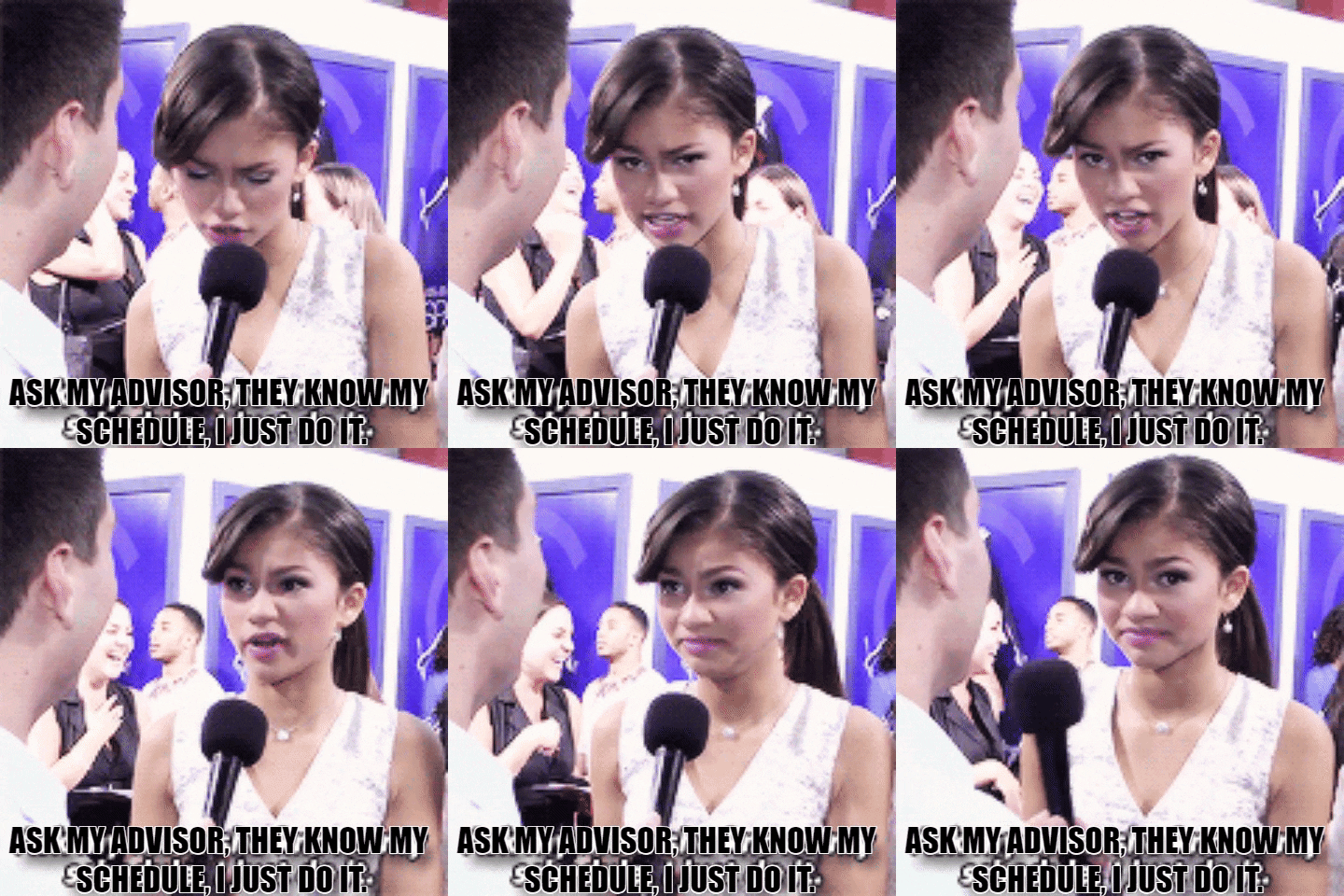
One of the best resources you have at your disposal is your advisor. Everyone has one, everyone needs one. Ask your advisor every question you can think of when creating your next schedule and if they don't have the answers you can ask the professor of the class for answers as well. They are there to help make sure that you are on track for graduation, and they will make sure you are taking every class you need to get you there. Even better, if you find that your advisor is not in the same department as your major you can get a new advisor by simply signing one form. The process is easy and can be done in an afternoon and you'll have all the help you need in finding the schedule that is perfect for you.

Back-to-Back, Nights, Weekends, Oh My!

The importance of the break has been researched before, and the idea of going from one class to the next will tire you out faster than you think. Make sure you give yourself plenty of time between classes to eat, relax, and study as needed.
There are classes that you can also take that will happen at night or during the weekend, and while these can be helpful in getting a schedule with no conflicts in it they have their own commitment. It is recommended not to take a night class unless you know you work well at night, otherwise, you may find yourself struggling with the classwork.

Focus on the Required Classes

Even if you know what major you are going to go for, focusing on the general education classes first can save you from having to take a non-interest class your senior year. If you focus on getting through all of the science, history, and writing intensive classes first then you will be free to enjoy the classes for your major as you wrap up your college experience.


There are many more tips out there for creating the perfect class schedule. Look around for what will best suit you and don't be afraid to ask your advisor or professors of classes that you're interested in for help. They're there to help you and your academic career!


Sources

5 Tips to Creating the Perfect College Class Schedule
8 Tips for Choosing College Classes

Advocating Info Graphic

By Paige Waskow

As a follow up to the previous post on advocating for yourself, this info graphic is a quick guide that sums up what you need to know!


View here!

If you have any questions or other tips for advocating for yourself, please leave them in the comment section below.


Resources:

Choi, Lily. “How to Advocate for Yourself as a Woman of Color in the Workplace.” How to Advocate for Yourself as a Woman of Color in the Workplace, The Everygirl, 20 June 2018, theeverygirl.com/being-a-woc-in-the-workplace/.

Patel, Deep. “10 Powerful Ways to Stand Up for Yourself in Any Situation.” 10 Powerful Ways to Stand Up for Yourself in Any Situation, SUCCESS, 4 April 2017, www.success.com/10-powerful-ways-to-stand-up-for-yourself-in-any-situation/.

Galinsky, Adam . “How to Speak up for Yourself.” How to Speak up for Yourself, Ideas.ted.com, 17 Feb. 2017, ideas.ted.com/how-to-speak-up-for-yourself/.

McLeod, Lea, Feeling Frustrated? How to Advocate for Yourself at Work. The Muse, 5 July 2013, www.themuse.com/advice/feeling-frustrated-how-to-advocate-for-yourself-at-work.

Nunez, Vivian. “Self-Advocacy Is A Learned Skill.” Forbes, Forbes Magazine, 17 June 2016, www.forbes.com/sites/viviannunez/2016/06/17/self-advocating-is-a-learned-skill/#13e24f787f14.


More Advocating Tips!


By Paige Waskow

There are many parts to advocating for yourself, and as the last post mentioned, being uncomfortable, actually doing something, and learning to stand up for yourself, are all key aspects. But what else can you do? Check out more advocating tips below to strengthen your methodology and confidence! In addition, look out for a summarized info graphic (of both advocating posts) coming soon.


1. Practice beforehand

Going into a conversation, you want to know what you are going to say and how you are going to present a concern. A great way to do that is to talk to a friend, classmate, or even yourself to make sure that you are ready to talk, especially if you are nervous. Just like studying helps you remember things, talking and having a plan is a great way to have confidence.

2. Know what you want before you talk

Expanding on the point above, it is beneficial to know exactly what you want before you have a conversation. This clarity will help you avoid stumbling around and missing the actual point you originally wanted to make. As an article from The Muse states:

"She and I then framed those points in a way that would show how these issues, when resolved, would help her team, her manager, and the entire organization. By leveraging your talking points this way, you can effectively turn what may sound like complaints into something much more positive for everyone on your team," (McLeod 2018).

Although this is specific to a workplace environment and employee, it is applicable to most situations. Preparation, understanding what you really want in the conversation, and practice allow for a better outcome. It can be helpful to think about how someone might respond. For example, you may ask your professor for more time on assignments. Of course, this could be answered in a multitude of ways, but you may expect that you professor would be hesitant to do so without legitimate reasoning. In this case, preparing why you feel that there should be more time for assignments helps make your request stronger and more likely to be considered.


3. Have someone accountable for your actions

It is always good to have support! Having someone keep you accountable for standing up for yourself is incredibly important. It will help you actually do the thing you set out to do and remember your goals. This could be anything from asking them to ask you how a conversation went or reminding you over text as a way to motivate yourself to do it. Often, when we are confronted with something uncomfortable, we immediately believe ourselves to be entirely alone. But this is not true and having someone on your side supporting you makes you more confident and eager to do so.

4. Keep a list of ways that you stood up for yourself

Okay, this may seem weird, but keep a list! It can help you remember what you have accomplished and why it meant a lot to you. You can use the list to motivate yourself and be a source of confidence for future events.

5. You may be helping others!

Especially if this is a widespread issue, you are advocating for others as well. Like the saying that when you have a question in class, someone else is wondering the same thing, if something is bothering you in a group situation, it is probably bothering someone else too. Often in society, we convince ourselves that our issues are not shared and therefore not important. If you struggle with this, remember that we are not as polarized and independent as we believe. In addition, it is always important to advocate for yourself, even if you are the only person who wants change.


6. Remember the other person

Although you should be assertive in what you want and need, be aware of the person you are talking to and their experience. Mostly, this revolves around reminding yourself of the following:

-   People are not mind-readers, and may have no idea what they are doing or how something is working is unfavorable to you. If they did not know beforehand, it does not mean they do not care.

-   Most people are willing to listen and understand why you are advocating for yourself. Respecting someone else when going into a conversation is crucial to its success.

-   How you come across is important. Complaining to or blaming someone will not get you the most favorable outcome (this is why you should plan your points ahead of time and practice!)


--------------------------------------------------------------------------------


I want to add that this may be particularly difficult for many people in society and in certain situations. There is often a lot of backlash or disregard of importance when a person tries to advocate for themselves. Being a woman, person of color, part of the lgbtqia+ community, physically disabled, pregnant, Muslim (or of another religious group), or having social anxiety can affect how people are treated and viewed when speaking up (and this is not a complete list).This is not to alternate confidence of speaking up but to address that this is a real problem we have in society. The more we address it and talk about it, the better we can support ourselves and others to be more confident in how we advocate for ourselves.


Resources:

Choi, Lily. “How to Advocate for Yourself as a Woman of Color in the Workplace.” How to Advocate for Yourself as a Woman of Color in the Workplace, The Everygirl, 20 June 2018, theeverygirl.com/being-a-woc-in-the-workplace/.

Patel, Deep. “10 Powerful Ways to Stand Up for Yourself in Any Situation.” 10 Powerful Ways to Stand Up for Yourself in Any Situation, SUCCESS, 4 April 2017, www.success.com/10-powerful-ways-to-stand-up-for-yourself-in-any-situation/.

Galinsky, Adam . “How to Speak up for Yourself.” How to Speak up for Yourself, Ideas.ted.com, 17 Feb. 2017, ideas.ted.com/how-to-speak-up-for-yourself/.


McLeod, Lea, Feeling Frustrated? How to Advocate for Yourself at Work. The Muse, 5 July 2013, www.themuse.com/advice/feeling-frustrated-how-to-advocate-for-yourself-at-work.

Nunez, Vivian. “Self-Advocacy Is A Learned Skill.” Forbes, Forbes Magazine, 17 June 2016, www.forbes.com/sites/viviannunez/2016/06/17/self-advocating-is-a-learned-skill/#13e24f787f14.

How do you ADVOCATE for yourself?


By Paige Waskow

Advocating for yourself can often be really hard. Like, really REALLY difficult. You may have to talk to a boss, a professor you dislike, or a friend who is making you uncomfortable. It may be as simple as asking your roommate to turn off the light at a certain time or as complicated as asking for funding for research. Yet, we need to advocate for ourselves. It is an incredibly helpful skill to have and will help you move forward to do the things you want to do. You will be able to gain confidence and compromise with others, while pursuing your goals and needs. By starting now, you will benefit yourself in future jobs and interactions with people.

Here are three tips and reminders about advocating for yourself:

(In addition, look out for more tips in an additional posts coming soon!)


1. It might be uncomfortable or put you in an awkward position, but that is okay

Standing up for yourself is often uncomfortable. It is an active action and requires stepping out of passivity and not accepting the current situation to ask for what you want. It may not be received well or you may not get the answer you want. The goal is not to change everything to be perfect but to address a particular need or concern. In addition, talking about a problem when it first comes up allows for you to hopefully avoid further complication and make your insight heard.

2. You need to actually do something about it

It is really, incredibly easy to do nothing at all. It is even easier to gossip about a problem and perpetuate how upset you are about it. This may be obvious, but this solves absolutely nothing. If anything, it may make your problem worse. The person may take offense to gossip and make it harder for you and your wants to be acknowledged and taken seriously in the future. It takes courage and uncomfortability to talk to someone, as mentioned above, but it is your best chance at getting an outcome that is favorable to you. Without taking that step, the situation you are in will continue to be the same.

3. Advocating for yourself will get easier with practice and is a learned skill

Small steps:

Although you may and can accomplish a big advocating goal whenever you want to, it is often helpful to get in the practice of starting small. Practice figuring out what you want or what you see a problem with. This is not to say you should always feel the need to address everything, but if you have a legitimate opinion or concern about something, have the conversation. This will help you prepare for the future, become more comfortable talking to others, and build the habit to address a pressing concern.

Small wins and compromise:

Not every conversation will go well or how you want it to. Perhaps your teacher did not understand why you think that their homework assignments are sporadic and do not help you learn. Or maybe, your boss will not change your shift exactly how you want it. This can be extremely frustrating, as we often have one idea of the perfect situation, however, small wins can be a big deal and so can compromise. By creating even that small change, you have changed something. And now, the person you talked to knows it is a concern to you! Your situation will most likely be more in your favor. In addition, remember that you have the right to ask and your concern is legitimate.


--------------------------------------------------------------------------------


I want to add that this may be particularly difficult for many people in society and in certain situations. There is often a lot of backlash or disregard of importance when a person tries to advocate for themselves. Being a woman, person of color, part of the lgbtqia+ community, physically disabled, pregnant, Muslim (or of another religious group), or having social anxiety can affect how people are treated and viewed when speaking up (and this is not a complete list).This is not to alternate confidence of speaking up but to address that this is a real problem we have in society. The more we address it and talk about it, the better we can support ourselves and others to be more confident in how we advocate for ourselves.


Resources:

Choi, Lily. “How to Advocate for Yourself as a Woman of Color in the Workplace.” How to Advocate for Yourself as a Woman of Color in the Workplace, The Everygirl, 20 June 2018, theeverygirl.com/being-a-woc-in-the-workplace/.

Patel, Deep. “10 Powerful Ways to Stand Up for Yourself in Any Situation.” 10 Powerful Ways to Stand Up for Yourself in Any Situation, SUCCESS, 4 April 2017, www.success.com/10-powerful-ways-to-stand-up-for-yourself-in-any-situation/.

Galinsky, Adam . “How to Speak up for Yourself.” How to Speak up for Yourself, Ideas.ted.com, 17 Feb. 2017, ideas.ted.com/how-to-speak-up-for-yourself/.

McLeod, Lea, Feeling Frustrated? How to Advocate for Yourself at Work. The Muse, 5 July 2013, www.themuse.com/advice/feeling-frustrated-how-to-advocate-for-yourself-at-work.

Nunez, Vivian. “Self-Advocacy Is A Learned Skill.” Forbes, Forbes Magazine, 17 June 2016, www.forbes.com/sites/viviannunez/2016/06/17/self-advocating-is-a-learned-skill/#13e24f787f14.

Just Posted

A Fresh Start: Embrace the Spring Semester with Library Resources

 ðŸŒžAs we settle into the second semester, it's the perfect time to hit "refresh" and embrace new beginnings. The cold winter m...