Becoming an Iowa Resident

Image Source

“Why would you ever want to live in Iowa?”, you ask.
I’m from Chicago, arguably the greatest city in all of the Midwest. Doesn’t it make more sense for me to leave the big city and go to another big city, like LA, New York, Rome, or Paris? 

Why I Love Cedar Rapids
I really enjoy Iowa. There are dramatically fewer residents here than Chicago, and they're nice. I’ve lived here for two summers (and two school years) on campus, and worked downtown. I’ve contributed to the local CR economy by shopping at Moss and Daisy’s Garage, as well as taking the city bikes around town. When I walk down the street there aren’t millions of other people walking down the same street, nor cars honking their horns and running over people; although people here are noticeably reckless drivers so there is definitely a similarity. There’s a lot more to CR than Coe, and exploring it with my local friends has helped open my perspective to a different way of life. 

It’s harder to get lost here, and people will help you get around. The downtown park is no Grant Park, and Lake Michigan is a national treasure, but Ellis park has its own perks. Being right on the water,  with houses that float with the floods is unique to this city and there have been many other improvements after the Great Flood. For example, the NewBo district (with electric car charging stations) and more bike lanes.

Why I Love Chicago
My family is spread across the US, but my main branch (the HQ) is still there. Grandma still lives  in the old neighborhood (for some reason), my aunt is the 'burbs. I grew up in the apartment my Granny owned, and my family was always together. I have such fond memories of a place that doesn't exist anymore. My preschool, grade school, and high schools (I transferred) are all there. Italian Fiesta pizza, Maravillas burritos, and sugar buns from China Town all hold strong memories. Even White Castles, since it doesn't exist in this entire state; I'm not salty... The rocking of the sky trains, or L if you care about "proper terms", the quiet of the Barnes & Noble down State Street, and the smell and feel of the lake effect are unforgettable. Quite frankly, there is not enough diversity here. I'm used to being surrounded by tons of different types of people: race, ethnicity, religion, accents, etc., but here, it's a culture shock. My childhood is there, as well as everything I'd grown accustomed to. But, I needed a change from the hustle and bustle, so here I am. 

The Cons of CR
I do not like CR’s transportation system. It’s pretty terrible, especially when coming from a city where you could take a bus or train pretty much everywhere. I didn’t need to know how to drive or obtain a license, because I could take the CTA. Besides, city traffic in the windy city has made world records with how slow the travel time is, and parking is way too expensive. Here, you can’t get anywhere without a car. The public transportation system is not considered reliable for very good reasons. Grocery shopping, vet trips for your puppy, volunteer work at nonprofits, and your off-campus job, all require a car. Fortunately, Coe isn’t in the middle of nowhere, and if you’re willing to, you can walk downtown. But, for people like me who have worked multiple jobs downtown, walking 40 minutes there and back every day and/or night is not a task for the weak-willed. 

Personally, the weather could be better. The past two winters have been awful. It’s so cold, and the snow doesn’t even stick around for very long. The lack of wind on hot days is bothersome, and the sun can beam down all it wants because there aren’t skyscrapers blocking it. Yikes, it's so humid in the summer my friends from Arizona complain about the heat. Oh, and you can't escape the bugs

When I went back to Chicago, I realized just how tall our buildings are, compared to Iowa’s. The concept of a skyscraper doesn't really excite you when you've been surrounded by them your whole life. Those buildings are offices, that mall is a mall. Now that I've spent some time away, I can see what the hype is about. The Water Tower Place is massive. Everything is massive. It would be an immense shock to people who think CR is a big city. Chicago has the most amazing architecture, with newer and older structures right next to each other. Still, I'll take the CR library any day - though, Harold Washington will always have a place in my heart. 

The Cons of Chi-Town
Illinois is known for corrupt politicians, and Chicago is no exception. Did you know the nickname of the windy city isn't because of the wind - since it's windier here (I can tell) - but because of all the hot air flowing from the politicians? (The more you know) The increase in certain types of taxes hurts some more than others, and the some definitely hit the poor more than the rich. I won't get too deep into this rabbit hole, but it's not fun to turn on the news and be reminded of the horrible actions of people you're supposed to trust. Sure, the salaries may be higher, but the cost of living is extremely high! It’s far less expensive here in CR. The cost of living is 27% higher in Chicago, for example, if you earn $60,000 (after taxes) in CR, you'll need to earn over $76,093 to maintain the same standard of living. If you wanted to own a home in Chicago, you'd pay around $517,613. However, in CR that house would've only cost $327, 616. That's a $16,000 difference in yearly earnings, and $190,000 difference in price! No, I will never pay that much for a property, just because it has a scenic view, but thank you for asking. As a young adult, I need to be able to live where I can afford to live. I take my finances very seriously, and don’t plan to live in the most expensive apartment in the most expensive part of the city, just because.

This may come as a shock, but I don't want to be around a lot of people at once, and that's all the big city is. I know, it's hard to be both small and extremely diverse, but as long as a city isn't in the far millions, I'll be fine. I’d like a place with better public transportation than CR, but similar in population size. We’ll see how it turns out.

It's Different, Not Worse
To people from smaller towns, CR is a big city. To me, it’s a town, right? I know, typical city girl response, but honestly, this city is tiny, and I love it. I can walk around and not bump into anyone, unless it’s the lunch rush. The amount of interaction you must have with strangers goes down immensely, and it’s refreshing for my introverted mind. I can be more open, more expressive and comfortable being myself. It’s darker at night and streetlights aren't bursting through my windows. There are times when there is total darkness in my dorm and I don’t even need special curtains; it’s fantastic. I don’t know if it's a small town/city mentality, but people here are so nice. They smile at you when you walk past, ask how your day is, compliment your sneakers, the whole shebang. Downtown there are small shops where you can walk in and not be surrounded by grumpy people who are groggy even after five cups of coffee. I always recommend walking around to get the full experience while you're here. The Czec Village, the African American Museum of Iowa, and the downtown public library are only a handful of places you should visit.

A Change of Scenery Can Only Do Good
I have always wanted to leave Chicago and explore the world. I want to see the stars and even live somewhere where my children can see them every day. I want a backyard vegetable garden, and a tiny home for stray cats to keep out of the rain. There is still a lot of time to plan for that change, but for now I want to continue to explore. Working at Jimmy John’s and Greyhound Deli has allowed me to meet real people who live here and see how they live their lives. There’s so much more than just what I can walk to. I volunteered at Dogs Forever and saw the Kernels Stadium. The White Sox will always be the best, but hearing children sing the pledge of allegiance brings a smile to my face. The differences between the many different Hy-Vees, and the wonder that is Cassie’s pizza all have their charm, just like Chicago. The tourist destinations will always be there for me to visit. I'll see my family during the holidays. It's good to leave your bubble, so you can see how small it is. You learn more about yourself and the world around you. The limited options for Mexican food saddens me, but Pancheros is pretty decent. I needed space from all I was used to, and being in Iowa has allowed me to do this. In conclusion, would I live in LA, New York, Rome, or Paris? The answer is no. 

Author's Note:
There are pros and cons to every situation you find yourself in. It's important to make the best decisions for yourself, especially you're the one that will have to live with your decisions.


Sources
Compare your dream city to your hometown using this cost of living calculator and city livelihood comparison
Windy City debate: click here.


Giphy Source

Back-to-School Blues: Starting The Year Off "Badly"


Photo Credit
By Arabella Chamberlain

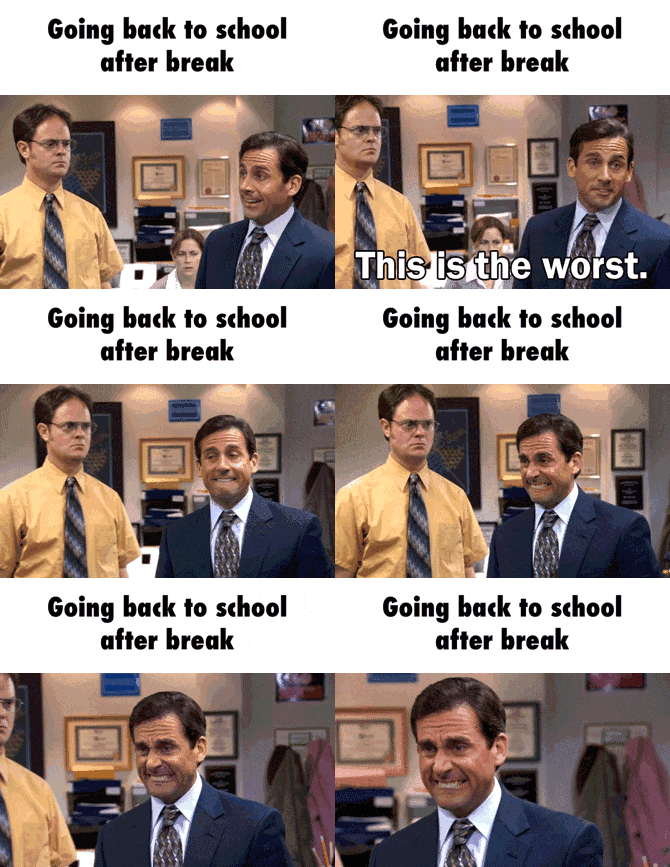
You made it back! By now, you're probably all moved in, unpacked, and have gone to class (hopefully...). But have the back to school blues already hit?

Coming back to school can be a hard transition for everyone. Yes, you're surrounded by all those friends you've been missing for months over the summer and you're seeing old faces and visiting the Library or sitting in the hammocks. But you've also left behind family and friends back home, the carefree lack of a schedule most days, or maybe that extra busy summer job... But hey, at least you're not broke anymore.
Photo Credit

It can be easy to feel stuck in a rut when trying to get back into the swing of assigned readings and problem sets and 5-page essays. But don't let that stop you from making this year your best year yet! Even if you're the most organized and efficient and "on-top-of-it" student, here's some tips to guarantee this will be a school year to remember:

  • Get a tutor... the sooner, the better! (Even if you think you won't need it!) It's easy to think, "Oh, this class is gonna be so easy" when you're only a week and a half in, but by the time that daunting midterm rolls around, you'll wish you'd at least taken the steps to get a tutor. Requesting a tutor is the hard part (and it's not even that hard!), going to a tutoring session is the easy part! As long as you show up ready to work, your tutor is ready to help.
  • Grab a planner (or get your Google Calendar organized!) I can't even tell you the number of assignments and meetings I'd lose track of if not for the gift of Google Calendar and Tasks. I'm a pretty forgetful person... and it shows when I run into a meeting 10 minutes late! But if you can get into the habit of keeping a calendar, digital or otherwise, it'll be so much easier to figure out when you can stop by a professor's office or scheduling that tutoring session I just mentioned ;) . Don't take a simple planner for granted. It can be a lifesaver.
  • Talk to your professors! They have office hours for a reason. As much as I'm sure professors love sitting in their office grading papers nonstop, I'm sure a visit from a friendly face is a nice break from all those problem sets or essays on Tolstoy. Your professors have office hours for YOU. That's a time that they've devoted to helping out any students that need help outside of class time. Though it can seems daunting to knock on their door, stop by and have a chat, even if you're doing well in a class. The better a professor knows you, the better they can help you learn and grow.
  • Take a break sometimes. If you find yourself overwhelmed and feeling like you've got way too much on your plate, know when to say "no." Don't overextend yourself and regret not giving something your all. It can be easy to join this club and take on this job and volunteer this place, but you need to draw a line for yourself and know your limits. If you bite off more than you can chew, when are you going to have a chance to relax? When will you get the time to enjoy your college experience. Coe has so many amazing things to offer, but don't let that stop you from actually enjoying them. Take time for yourself.

Photo Credit
All in all, whatever you do this year will be enough. Set goals and work for them, but if at first you don't succeed, don't let that get you down. Whatever little milestones you've accomplished along the way are still milestones - remember that! I recently heard an interesting little quote that I think sums up my approach to this upcoming year:

"Anything worth doing is worth doing badly"
-G. K. Chesterton

Keep up the work - good or bad!

Photo Credit

What Time Is It?: How to Spend Your Summer Wisely

by Arabella Chamberlain

Summer break is so close you can taste it. It's starting to warm up and the freedom of Summer is right around the corner. Maybe you plan to kick back by the pool and enjoy some sun. Or maybe you'll spend your summer inside, curled up with a novel or two. But what are some ways to make your summer productive?
  • Get that practicum requirement out of the way early. If you're a freshmen or sophomore, summer is a great time to complete your practicum so you won't have to worry about it as graduation draws closer and closer. Upperclassmen, definitely get your practicum done over the break so you can spend your Junior and Senior years working on other things, maybe even studying abroad. Take advantage of your summer.
  • Do a May term. It's a little late now to do a May term this year, but keep this is in mind for next year. Get a Gen Ed out of the way and explore exciting, new places. Many professors have already started talking about their May terms for next year so maybe do a little research and plan your summer next year!
  • Photo Credit
    Get a summer job back home. Need a little extra cash over the summer? Look into local summer work. Start reaching out now and looking for seasonal work at small businesses or go back to places you've already worked and see about temporary work. It can't hurt to ask and see what happens!
  • Catch up on some summer reading. Get a tan poolside. Get outdoors. Live your life. Have fun and enjoy your summer! Honestly, just do what you want to do this summer and that's the most productive you can be. See you next Fall!

BOTW 4/22

By Paige Waskow


The Water Will Come:
Rising Seas, Sinking Cities, and the Remaking of the Civilized World

by Jeff Goodall


What is it about?

As climate change and sea level rise become more and more relevant to our lives, what happens to the cities and people on the coast lines? Jeff Goodall dives in the history of water, our present struggle with fighting flooding, and what to expect as we welcome our underwater future.

He gives many examples of cities that have watery histories and presents such as Venice, Miami, and New York City. From reporting on good solutions or band-aid over bullet hole type plans that cities have, much like the title, Goodall explains what is happening with rising sea-levels and how we will have to face them no matter what.

                                                
       via GIPHY


Why did I choose it?

I read this book during July 2018 while camping in Colorado. Although the book was mainly about water systems, it also talked about other climate change affects taking place in our world right now. As I sat and read under the pine trees being killed by thriving beetles, Goodman described the phenomenon and how it connected to climate change. I literally was able to look up and see the dying trees. I was able to see the effects of climate change in action, and it was mind blowing.

Goodall does a great job of making climate change real and relevant. Often, we see climate problems as something far away or as a future problem. Although it will be a future problem, it is also a now problem. In his reporting, he describes many cities and how we are already struggling to manage changing water systems. I found the writing to be a fantastic mix of scientific data, dialogue, and storytelling. This book is so interesting and gave real insight to what we are facing as a world. I highly recommend it to anyone who is looking to learn more about climate change or simply wants a good book to read.


Where can you get it?

This book is available at the Cedar Rapids Public Library. You can get a library card for free anytime the library is open. The closest location is downtown on 4th street. You can visit their website here!


Happy Reading!

Declaring a major: What am I doing with my life?

It can be daunting when one realizes that you don't go to college just for the friends and the weekends. In fact, sometimes it might even feel like, "what's the point of college anyhow?" This is a valid feeling especially after you pour yourself into class after class and you start to wonder what for.
Me, not fine with deciding my futurePhoto Credit

Then, sophomore year hits.

"Declare a major," they said. "It'll be fun," they said.

But is it really? One of the biggest decisions of your life and "it'll be fun." I doubt that. Choosing a major is pretty intense to be honest. It's like saying "when I grow up, I wanna be" - *insert childhood dream* but instead of your parents reassuring you and saying you can achieve your dreams, they rip off the bandage and tell you could never be a *insert childhood dream* and even if you do, you won't make any money and it's a horrible business to get into. Phew. And I thought my parents were tough.

It could definitely be worse. You could be this guy:

Even more not fine with deciding my futurePhoto Credit

But is choosing a major really as terrible as it seems? What can you do to choose the right major?

Things to do when choosing your major:
  • Talk to your academic advisor. They've gotten you where you are so far, why not let them help out a little more? Since they've already spent at least a year getting to know you and helping you pick out classes, they're a great resource to see what majors might be good for you. They may even suggest something you did even realize you loved. Say you took a bunch of English classes when you kept telling yourself to be a Bio major. Your advisor can help you spot these things.
  • Reflect on what your favorite classes have been. Think back on all the classes you've taken. Which have you been most passionate? Done well in? Seen yourself going into this kind of career? Looking back at past experiences can be really helpful to deciding a major. You wouldn't want to become an Econ major if you hated every Econ class you've taken.
  • Visit C3 to get an idea of what life after college looks like for your major. C3 is one of the best hidden gems on campus for where to get advice about after college. When you graduate, do you see yourself getting a job right away? Going to grad school? No clue? C3 can help talk you through the options with whatever majors you're interested in. Even if one major suggests you can't go straight into the workforce after graduating, C3 could probably set up a meeting with a Coe alum who did! Don't be afraid to go in and ask questions over in McCabe.
  • Remember, you can still change your major. Just about until you graduate, you can always change your major. You can even add majors sometimes. On the flip side though, don't get bogged down thinking you can't escape your poli-sci-history-psych-neuro-chem quintuple major. You don't have to do it all. If your major doesn't want to stick, you can still change it. Figure out what's right for you.
  • You'll find the right major. Cap believes in you: Photo Credit
  • Follow your heart. Cheesy, I know. But honestly, pick a major that will make you excited to be getting an education. Sometimes people around you can try to tell you that "you should do this" or "don't do that," but it's your life and you can't let others live it for you. Listen to your friends and family's suggestions, but remember, that's just what they are - suggestions - don't be afraid to go after your dreams. Because choosing a major is pretty major.

BOTW 4/15

By Paige Waskow

White Privilege: Unpacking the Invisible Knapsack

By Peggy McIntosh

The book of the week is not exactly a book. Instead, I thought I would post this resource about white privilege.


What is it about?

This resource, which comes from a larger publication by McIntosh, helps identify what white privilege looks like in everyday society. This list of statements allow the reader to look at their own lives and see how they are able to interact with the world in comparison to others. White privilege does not always mean active violence, it is ingrained in every part of society.

Here are the first seven (out of 50) examples from McIntosh's list of what white privilege looks like:

"1. I can if I wish arrange to be in the company of people of my race most of the time.

2. I can avoid spending time with people whom I was trained to mistrust and who have learned to mistrust my kind or me.

3. If I should need to move, I can be pretty sure of renting or purchasing housing in an area which I can afford and in which I would want to live.

4. I can be pretty sure that my neighbors in such a location will be neutral or pleasant to me.

5. I can go shopping alone most of the time, pretty well assured that I will not be followed or harassed.

6. I can turn on the television or open to the front page of the paper and see people of my race widely represented.

7. When I am told about our national heritage or about "civilization," I am shown that people of my color made it what it is" (McIntosh 1988, 2).


Why did I choose it?

I think this resource is a great way to target what privilege looks like for white people. What I mean is that as a white person, I am able to ignore or more seamlessly move through society in a way that people of color cannot. I get to choose whether or not I want to think about how society is privileged to white people. I do not have to experience it.

All of the statements that McIntosh mentions are crucial to understanding what white privilege looks like, and they should make you uncomfortable- especially if you are not a person of color. I think this source challenges my normal and helps me remember to be aware of what I can do without feeling awkward, fearful, isolated, or ignored because of the color of my skin. It is so so so important that those who have privilege in society challenge themselves to see bias and then change how they act or don't act. One thing that I have learned is that listening and learning go a long way. Unpacking the Invisible Knapsack is a way to actively listen and challenge the status quo.


Where can you view it?

Right here! This is a PDF document of the list (but not the whole publication).


Is there anything else you should know?

If you would like to view another post I wrote about white privilege, you can click here. I added some resources that I have found useful to that post. Additionally, if you have any resources, comments, or questions, please leave them below. Happy reading!


References

McIntosh, Peggy. 1988. "White Privilege: Unpacking the Invisible Knapsack." (part of "White Privilege and Male Privilege: A Personal Account of Coming To See Correspondences through Work in Women's Studies") https://www.racialequitytools.org/resourcefiles/mcintosh.pdf. April 17, 2019.

Gen Z Finances: Investing for Beginners

"To get rich, you have to be making money while you're asleep." 
~David Bailey
What comes to mind when you hear the word "invest"?  
You probably imagine a stuffy man with a suit, smoking a cigar, leaning on a limousine. Basically, some rich guy. As a novice investor, it was nerve racking to try and get started, since this image that you have to already have a lot of money in order to invest clouded my mind. But, I'm determined to get ahead of my student debt, and build financial freedom for myself. Today is a crash course in investing as we learn the amazing opportunities for our money to grow. 

What is Investing? 
To begin our journey into financial freedom we’ll start with investing, something people do very little of. Investments are seeds that you plant and grow into beautiful flowers. Investing is the act of taking those seeds and planting them. There are so many options when it comes to your money garden. You can start indoors or outdoors, you can use fertilizer or dirt from the park, you can water it every day or every month, and the list goes on. Depending on your goal you may want the flower to grow fast, so you use a “best-seller” fertilizer with the added risk of, possibly, killing your plant. You may decide to play it safe and let it grow at its own pace. Either way, there is a chance your plant will grow.

This gardening metaphor is how I understand investing. You use the money you have now to build wealth for the future. According to the Financial Industry Regulatory Authority (FINRA), you can invest (your money) in stocks, bonds, investment funds, bank products, annuities, and options. They also include retirement savings, college/education savings, cryptocurrencies, commodity futures, security futures, and insurance. Nerdwallet adds exchange-traded funds (ETFs) to this list. You can read about all of these investment opportunities in the links provided, but we're beginners, so we'll be excluding a few of them. 

Investing vs Saving
Your savings is the money you put aside to be used another day maybe four months from now or even 30 years from now. Most savings accounts gain interest once a month, and add a few cents to your account. The longer you save and the higher amount of savings you have, the higher the interest you gain. But, these profits are small. There are checking accounts that gain interest depending on how much you keep in your account, but most don't gain interest at all. In fact, some banks charge you a monthly fee for storing your money with them. We'll look at saving in more detail later, but for now you need to know how it differs from investing. 

There's a common misconception that investing and saving are the same thing, but that investing is far more risky. This makes saving seem like the "better option" since you're "guaranteed" not to lose money. After all, you can gain interest on both. I believe this misjudgment comes stems from not understanding interest. The banks are investing the money you save, this is why you receive interest. Why not invest your money too? You make more profit since it's not being filtered through your bank. Saving is essential for gaining your financial freedom, but investing can be just as rewarding, and even more so. 

Investing in yourself
Trying to find a definition of “investing in yourself” has proved troublesome, but here’s my definition for you: Investing in yourself is taking your time, money, and energy to better yourself in ways that will benefit you in the future. Rather than focusing on making a profit from your wealth, you focus on spending your money more wisely (or not at all). For example, setting aside time to read every weekend, allows you to de-stress and practice critical thinking. Books can cost as little as $0 to Barnes & Nobles prices, and you’ll be better able to handle stressful situations after winding down. Instead of going shopping every weekend, you take up a hobby or craft. There are A LOT of websites/blogs that talk about "investing in yourself", but the biggest takeaway would be to learn how to not spend money to be happy. Do something that makes you feel good for the long-term, rather than the immediate future. 

Why You Need to Invest
The concept of spending my money now to make more money has always appealed to me. As you get older, you tend to gain a better grasp on the concept of wealth and you learn your money habits. Whether we like it or not, we've already have financial obligations. Most college students have debt. We owe money to the government, banks, or other lenders who are helping pay for our education. Once we graduate we have six months until we have to start paying of these loans, and most people will be placed on a 10-year plan (by default). Right now, we have time on our side. We don't have to pay these loans back yet. Instead of spending all the money we earn, we can invest portions of it, to have more money in the future. In the future (closer than you think), we'll be heading to careers and/or graduate programs. Now is the time for trial and error, now is the time to learn the language and our investing preferences. We are young money. I know it sounds corny,  but we're the target audience when it comes to spending all our cash. If you're willing to spend your money, surely you're willing to make more. 

Ways to get started?
Now, how do you get started? We’re broke college kids (young adults). I'm glad to say there are many ways to get started, and depending on your goals certain options are better than others. That long list from FINRA and NerdWallet will come in handy, as we explore the best options for us. A huge part of choosing the best option is research, and, fortunately, I enjoy doing that. Down below are many wonderful links for your to do your own research. Stay tuned for my next post, which will focus on how to start investing and the best options for your needs.

Gif Source

Helpful Resources
There are many sites that you can learn more about personal financing. Here are some of my favorites:

Why young people aren't investing

Types of Investments

BOTW: April 10th

By: Paige Waskow


The Sun Does Shine:
How I Found Life and Freedom on Death Row

By Anthony Ray Hinton


What's it about?

What is it like to be on death row? What is it like to be innocent on death row? What is it like to be a black man, innocent of a crime but convicted for it, and on death row?

Anthony Ray Hinton tells his true story of growing up as a black man in Alabama, being accused of murder, and being sentenced to death. Not only is he completely innocent, but he spends thirty years of his life on death row before getting out. His story recounts the trial, the injustice and inequality of the system, and how he grows in spite of his circumstances. Hinton fully describes the hardship of being on death row and losing so much of his life to it. He speaks of his troubles with belief in God, fear of never seeing his mother again, frequently hearing and smelling men being killed near his cell, and struggling with how to get out. He also describes his incredibly journey in being able to make friends and share his knowledge with fellow men near his cell. He even starts a book club. Although he is in the worst of situations, he is able to serve the people who are on death row through kindness and compassion.


Why did I choose it?

This book affected me so deeply and profoundly. As mentioned above, it is not simply a story of injustice, but also one of strength and growth. Hinton has to face what I can only imagine as one of the most entirely life shattering and deeply horrifying experiences a person can live through. And yet, even after losing it all, he is still able to help other people. It is hard to describe the book without giving too much away, but I promise it is worth the read. I love books that challenge the status quo, and Hinton absolutely does this. But, he does it through love and compassion, which are seemingly impossible from being in the circumstances that he was put through. I highly recommend this book as it will challenge you, probably make you cry (or at least feel some serious emotions), and shares a powerful example about how love wins over racism, privilege, pain, sorrow, and inequality.


Where can you get it?

The Sun Does Shine is available at the Cedar Rapids Public Library (CRPL). You can get a CRPL card anytime for free.


Is there anything else you should know?

A part of the book recounts Hinton's journey to get off death row with help from lawyer Bryan Stevenson. I have written a few posts before mentioning Stevenson, specifically the BOTW post on Just Mercy which he wrote. If you are interested, you can view that post here. Additionally, I highly recommend checking out Stevenson's firm the Equal Justice Initiative (EJI). You can view their website here.

-----

References

Equal Justice Initiative. EJI. 2019. https://eji.org/

Hinton, Anthony Ray. Hardin, Lara Love. The Sun Does Shine: How I Found Life and Freedom on Death Row. St. Martin's Press, 2018.

What is Coe's Center for Creativity and Careers?


By Paige Waskow


Many people know or have heard of C3 here at Coe, but what do they do and how can they help you? How can you get that internship you've always wanted or make a lasting impression at a job? I talked with Joe Demarest, an Internship Specialist at C3, to ask some questions about what C3 does and how everyone can take steps towards having a successful post college career.


What is your job at C3?
So my title is Internship Specialist, but I deal with a lot more than just that. All the C3 consultants help with career exploration and consulting. We all help students get connected to Cedar Rapids and engage with community members.

What can students get help with?
I think it really is about meeting the student where they are at. One of the first questions I ask is: How can I help you? Not every student needs the same interaction and has the same needs. For some students it can be an interest inventory (like looking at majors) or job shadowing. Sophomores and Juniors typically do cover letters, job searching, and networking. It could be making the transition from the academic environment to real world.

What opportunity should every student take at C3?
I think every student should meet with us at least once to see where they want to be in the future. Different career paths may change how much a student interacts with C3. Their experience, if in the hard sciences, may be more professor based versus a student who wants to be in social work and needs help connecting with nonprofits. My biggest fear is a student leaving thinking that they are going to be happy but not having experiences and not having it figured out. Outside input is great for every student.

What are the most important things a student should do each year?

Freshman:
Freshman year is really about transition to college, 1st semester is getting into the new environment, and learning what you need to do to be successful. Asking: what might my future hold? And thinking about thing long term. Freshman should start trying different things and doing networking opportunities through C3.

Sophomore:
Sophomore year can often get lost in the mix. Ideally a Sophomore should start thinking more about how they can do some real exploration along the lines of summer opportunities and research. They should have more conversation about things like LinkedIn and start thinking about audience. Asking: How am I starting to engage? Some themes include: Internships to just get some experience. A working cover letter. More leadership opportunities in clubs. Considering life after college. (Grad school, working, etc.)

Junior:
Junior year is very important, you don’t want to slip through and not pay attention. It is a continuation of what has been done Sophomore year.

Senior:
Senior year is a lot about tying up loose ends such as practicums and ensuring that you are able to graduate. There should be more focus on life after college but still finishing strong.

In your experience, what kind of students stand out the most when applying for internships, jobs, etc.?

Those that start early (and it doesn’t need to be full throttle but it does need to be engaged.) Acknowledging time and how important it is and how fast it really goes. If you always think you have more time, you don’t realize how quickly it goes until it is gone.


What C3 event should every student attend?

You should attend all of them. The career fair is one that would be really good to go to. Getting to know local employers and opportunities even for 1st year students is very important. Getting on the company’s radar as an interested student and making connections can be really helpful. Sip and Socialize is another good event to attend. So many jobs are being landed through networking and being able to connect with alumni. Data shows that networking is key. It’s also about learning how to have those conversations with professionals when you leave college.


Thanks to Joe for taking the time to answer my questions!


Gen Z Finances: Building Wealth in College


I love money. I know, that sounds like Scrooge, but, we live in the USA, so understanding our capitalist economy and how to maneuver through it is essential for financial stability. Coe students come from all over the globe and we have our own ways of dealing with it. One fact we all have in common is that we’re legally adults now, with a ton of new responsibilities. Some of us have cars, and some of us don’t know how to drive. Some of us had a ton of savings set aside by our parents, and some of us had none. No matter your socioeconomic status or the size of your bank account, learning financial talk and how to build wealth are necessary skills to help you make it, or break it. 

The Purpose
These financial posts will be fueled by my own experiences and many different sources (both online and not). I wanted to learn how to handle the little money I have now in the best ways for my needs. Since I'm a novice in the field of finances, I wanted to help other beginners get started with building their financial future. If you're already intermediate, this advice will apply to you too. (I don't consider anyone advanced until they have a salary, and even then it's only a maybe.) To start, think back to your first dollar. It could be from your first birthday or that time your dad gave you a $20 and told you to "have fun". We all have experience with money, even if those experiences aren't shared. From a very young age we are taught the value of money by our parents and other family members. If your mom hands out twenties every time you do a chore, you're going to view this gift differently than your friend who only gets money on her birthday. I have many wonderful "money memories" to share, so keep your eye out for those posts to come. 

The Top Three Topics
When it comes to internet advice, I can lump most things into one of three categories: saving, investing, and budgeting. Saving is all the money you put away in your piggy bank or actual bank, to use another day. There are many ways to save money, and different types of savings accounts to aim for. Investing is money that you set aside to make more money. This can be through stocks, bonds, mutual funds, ETFs, and other methods. Budgeting takes into account how much you have earned and expect to earn, how much you'll put away in savings and how much you'll set aside for investing, as well as your bills, loans, fees, and subscriptions to pay off. Budgeting is probably the hardest one of the three to start, but it's arguably the most important. All of these topics and plenty more will be researched and written about thoroughly in posts to come.

Carrying On From Here
With this page we begin our journey into financial freedom. The world is a different place than when our parents were our age. Technology, the internet, new laws, and new regulations make entering this world easier than ever before. Unfortunately, it can also do the reverse. A simple mistake, a bad break, a horrible boss, a terrible injury, or a sudden death are also factors that influence your financial stability. Hopefully, through research and the resources provided, you'll learn how to make the most of our status as college students, before it's too late.  

Gif Source

Just Posted

A Fresh Start: Embrace the Spring Semester with Library Resources

 ðŸŒžAs we settle into the second semester, it's the perfect time to hit "refresh" and embrace new beginnings. The cold winter m...